






Quake Brutalist Jam lets gamers design their own playable concrete worlds



Cathedral-like concrete halls, menacing bunkers and monumental sculptural buildings were among the settings designed by Quake players for a brutalist-informed collective gaming event.
The third edition of the Quake Brutalist Jam saw participants create more than 70 playable maps for the online first-person shooter game over two and a half weeks.
It was co-hosted by Ben Hale, who works as an environment artist at game developer Unknown Worlds, where he focuses on landscape details, such as sculpting rocks, that make a video game come to life.

For the Quake Brutalist Jam, which he hosted together with Lain Fleming, Hale made the concrete textures used by creators to design the brutalist environments for the game.
"I made all of the texture sets that a lot of folks use in the brutalist jam," he told Dezeen.
"Concrete's interesting in that it's kind of a rock, but not really – it behaves differently, it oxidises and stains in its own kind of way. I had to do a bit of research to figure out how that looked."

The Quake source code was released in the early 2000s, enabling gamers to create their own modifications (mods) of the game. During the Quake jams, players try to build new versions of Quake, often around a theme.
"There are quite a few jams that would focus on a theme, whether that's a visual theme or a mechanical theme," Hale said.
"There was one called Blue Tuesday where everything was blue, and there have been a lot of Christmas jams."

Brutalism was a good fit for the Quake jam, not just because of Hale's expertise in texture design, but also because it suited the game's own style.
"Brutalism is a minimalist modernist style, and Quake's low-poly style matches it really well – besides the fact that nobody really went for super minimalism," he said.
"Modern tools have enabled mappers to become maximalist in really crazy ways; everybody's a little sicko for detail, but that's also fine," Hale continued.
"But I think it suits it well, because brutalism tends to be this very bold, singular, monolithic kind of style; it has a sort of capacity of becoming a landmark."
This marked the third year the Quake Brutalist Jam took place
A lot of the maps in the Quake Brutalist Jam convey an oppressive atmosphere – suitable for the gothic fiction-inspired Quake, in which players face off against monsters and explore secret areas.
"We love [brutalist buildings] because they're menacing, cool and a useful storytelling tool," Hale said.
"If you've gotten the chance to play through a lot of the maps in the Quake Brutalist Jam, you'll notice that everybody's interpretation, not just of brutalism but also of an oppressive atmosphere, are really different from each other," he continued.
While the requirement for creating maps for the jam was that the designs had to be made from concrete, "that didn't stop people from properly doing research, because they do care about this sort of thing," Hale added.

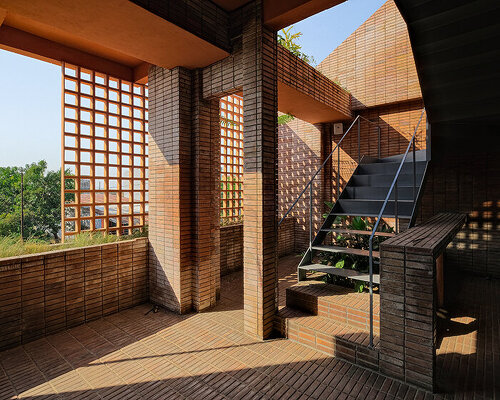
Among the many playable interpretations of brutalist architecture was game designer Robert Yang's map, which featured brick brutalism.
His map, which evokes early cult video game Myst, has a very open structure and layout informed by his research.
"You can approach it from any angle; it is an island with lots of intersecting loops for the player to come across, and his particular architectural choice specifically influenced the layout and design," Hale explained.

To Hale, game design and architecture aren't that dissimilar.
"Video game level design and architecture have a pretty similar goal: architecture is the design of space and flow," Hale said.
"That's precisely what video game level design is – now, granted, their goals of what that space and flow should accomplish can be pretty different," he continued.
"Typically, in gameplay, you want it to be mostly linear; games typically will try to get players from point A to point B with a couple of distractions along the way. Whereas in an actual building, every room is going to have its own use, you want it to be accessible."

Designing the brutalist Quake maps was a way of showcasing this relationship, while giving game designers the opportunity to feel like architects.
"One of the most magical things, I think, that you can experience, is being able to make a virtual space yourself and walk around in it," Hale said.
"Obviously, it's gonna pale in comparison to building an actual building and walking around in that, but this is kind of a cheaper thrill version."
Previously on Dezeen, we've spoken to the makers of The Sims about interior design trends and looked at Zaha Hadid Architects' creation of a parametric London for Epic Games.
The main image is from The Monument by Hale.
The post Quake Brutalist Jam lets gamers design their own playable concrete worlds appeared first on Dezeen.