








jongjin park transforms folded paper into porcelain sculptures that preserve every crease


Jongjin Park captures the memory of paper in porcelain
In Seoul, Jongjin Park works with materials that seem almost incompatible at first glance, bringing the softness of paper into the heat and permanence of porcelain. The Korean ceramic artist has developed a process that begins with ordinary sheets, dipped in watered down ceramic slip, tinted with hand mixed pigments, then folded, stacked, compressed, and fired until the paper disappears.
What remains is a ceramic body that still carries the memory of each crease, layer, and pressure mark, as if the kiln has translated a temporary material into something geological.
Park’s work sits at the meeting point between hand, fire, and material experiment. His sculptures — which won him the Loewe Craft Prize 2026 — appear soft, almost textile-like, with pastel bands and frayed edges that recall folded paper, patchwork, or sedimented earth. Their surfaces suggest collapse and pliability, but the objects themselves have become hard ceramic forms.
This tension is central to Park’s practice, which reframes unfired ceramics as a flexible state rather than a fragile one, allowing patterning and color to shift before the final firing fixes them in place.

Strata of Illusion, Jongjin Park | all images courtesy of Loewe Foundation, unless stated otherwise
porcelain that keeps the trace of paper
Jongjin Park’s method relies on a kind of controlled disappearance. He soaks sheets of paper in colored porcelain slip and builds them into dense blocks, sometimes through hundreds or thousands of layers. During firing, the paper burns away while the porcelain remains, preserving the fine lines and accumulated folds of the original material.
The process gives the work its strange double life: it looks light, fibrous, and almost temporary, yet it behaves with the density of fired clay.
The artist has also addressed the environmental and technical questions that come with firing paper at this scale. In a recent conversation with Colossal, Park explained that he uses recycled paper made from repurposed milk cartons and works with specialized kilns equipped with high chimneys to manage exhaust.
That practical adjustment adds another layer to the work’s position within contemporary craft, where material experimentation also means taking responsibility for process, waste, and transformation.

Strata of Illusion (detail), Jongjin Park
crafting the future through controlled collapse
Park’s sculptures can read like blocks of compressed time. Their colored strata bring to mind geological formations, while their folded surfaces carry the evidence of slow manual repetition.
Across works such as his stratum pieces, wall forms, and collapsed sculptural objects, he allows paper, slip, heat, and gravity to take part in shaping the final form. His hand is present throughout, but it shares authorship with the kiln.
Within the wider conversation around the future of craft, this is where Park’s work becomes especially resonant. His practice does not treat innovation as a break from the handmade, but as a deeper investigation into what a material can remember. Paper becomes ceramic, softness becomes structure, and craft becomes a way of holding uncertainty long enough for it to take form.

Strata of Illusion, Jongjin Park
Jongjin Park and the expanded field of collectible design
Based in the Republic of Korea, Jongjin Park holds degrees from Kookmin University and Cardiff Metropolitan University, and is currently Assistant Professor Major of Craft & Collectible Design at Seoul Women’s University. His practice moves between ceramics, craft research, and collectible design, with recent collaborations spanning luxury, fashion, and automotive contexts. In Strata of Illusion, those fields converge through a work that feels experimental without becoming remote.
The piece also speaks to a wider shift in design culture, where process has become as important as final form. Park’s ceramic method records labor directly into the object, allowing the finished surface to carry evidence of folding, pressure, pigment, and heat. At a moment when fabrication is increasingly shaped by speed and simulation, Strata of Illusion returns attention to the stubborn intelligence of matter, and to the hand as a tool for testing what a material can become.

the work’s hollowed center exposes a dense accumulation of folded layers preserved through firing | image courtesy of Jongjin Park

thousands of layered sheets that form the sculpture’s geological surface | image via @jongjinpark_ceramics

the artist arranges folded and compressed paper layers before firing them | image courtesy of Jongjin Park

colored porcelain slip creates sediment-like bands across the work’s textured facade | image courtesy of Jongjin Park

each sculpture records traces of pressure, pigment, and manual repetition | image courtesy of Jongjin Park

Strata of Illusion preserves the folds, creases, and textures of paper in fired porcelain | image courtesy of Jongjin Park

image by YB Kim via @jongjinpark_ceramics

image by Gallery Mosoon via @jongjinpark_ceramics

image by Gallery Mosoon via @jongjinpark_ceramics

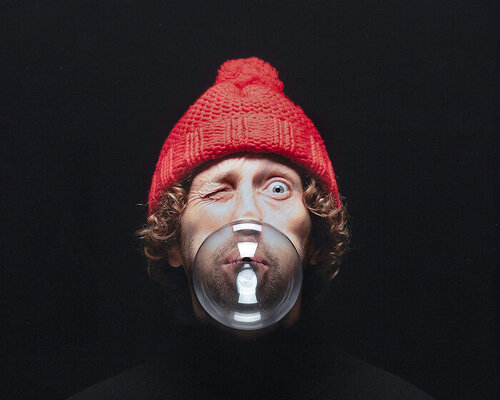
Jongjin Park portrait
project info:
name: Strata of Illusion
designer: Jongjin Park | @jongjinpark_ceramics
competition: Loewe Craft Prize 2026 | @loewefoundation
The post jongjin park transforms folded paper into porcelain sculptures that preserve every crease appeared first on designboom | architecture & design magazine.