





Live Sawn House features moving walls and a room on stilts



Japanese studio ICADA has completed a house in Saitama, Japan, that combines inventive storage solutions with a structure of rough-sliced cedar logs.
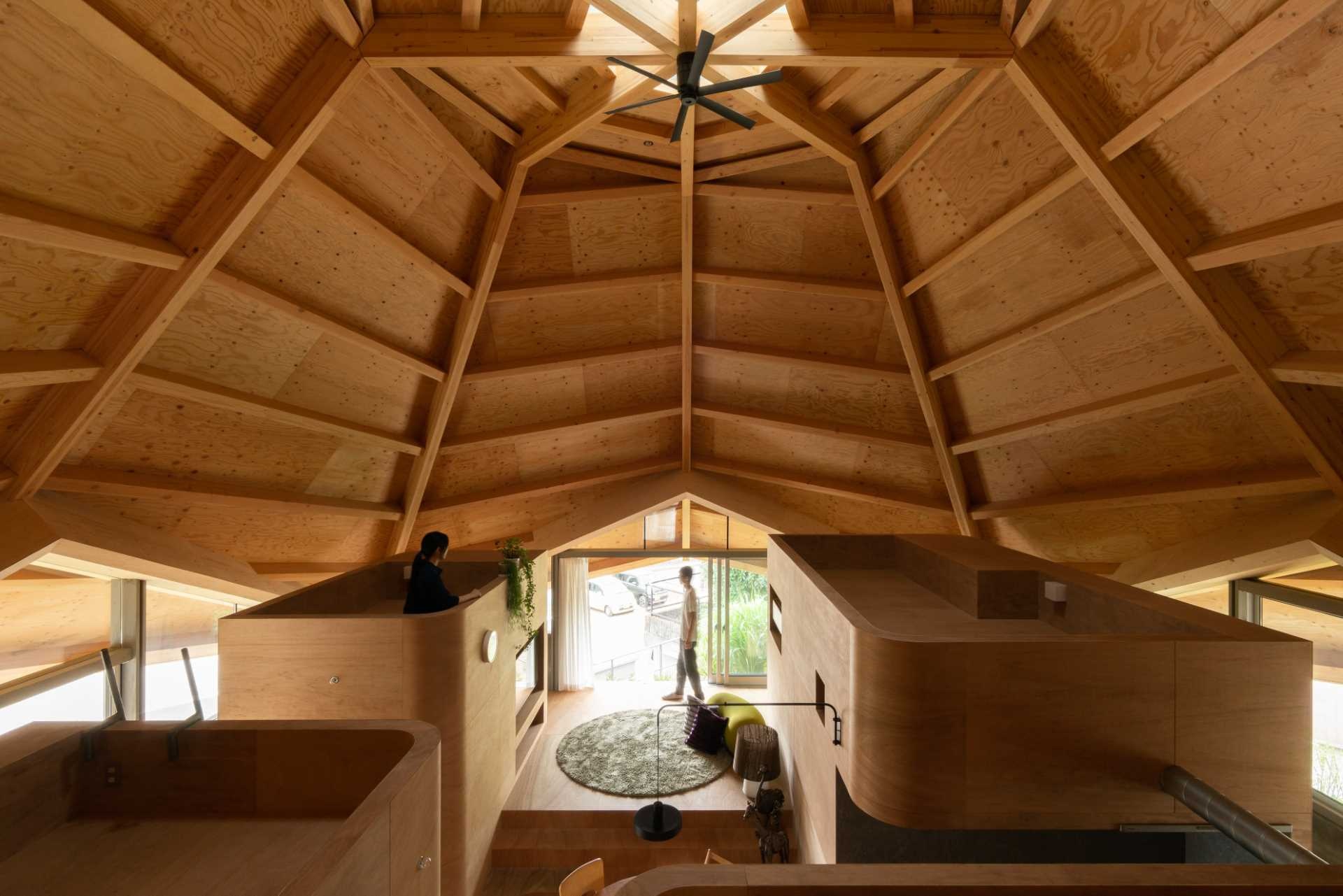
Live Sawn House features exposed wall and floor structures formed of cedar planks, which were milled as simply as possible with the edges left raw.

To optimise space on a "flagpole" site, the design also incorporates sliding bookcase walls that change the layout of the first floor, and a walk-in wardrobe that is raised on stilts along a narrow alleyway.
Architects and ICADA founders Masaaki Iwamoto and Nariaki Chigusa designed the two-storey, 113-square-metre home for a couple with two young children.

The family had a tight budget, which led Iwamoto to consider the potential of large-diameter cedar logs.
As a tutor at Kyushu University, located in the region where most Japanese cedar is grown, the architect had learned that thick logs are comparatively cheaper to source than thin ones.
This is due to a combination of factors. Firstly, unplanned reforestation after the second world war has created an oversupply of mature trees. Secondly, sawmills equipped with the machinery to mill large logs are increasingly rare.

"This means that trees cultivated over decades, often by previous generations, are sold cheaply and reduced to plywood, laminated lumber, or even wood chips," Iwamoto told Dezeen. "This affects not only profitability but also the pride of forestry workers."
"I began to wonder whether affordable yet expressive housing could emerge by using large logs at their natural scale rather than fragmenting them," he said.

ICADA sourced the timber from Kyushu, where proximity to Mount Aso (an active volcano) allowed it to be geothermally dried. This reduced both its carbon footprint and its cost.
A structural system was devised to make optimal use of the wood, with 105-millimetre planks used for wind-exposed and corner columns, and 70-millimetre planks used in places where the load is lighter.
"The building system is straightforward and legible," said Iwamoto. "Boards retain natural edges and occasional bark, enriching visual texture while minimising waste."
"Timber is oriented along the grain, ensuring high bending strength without industrial processing," he added.

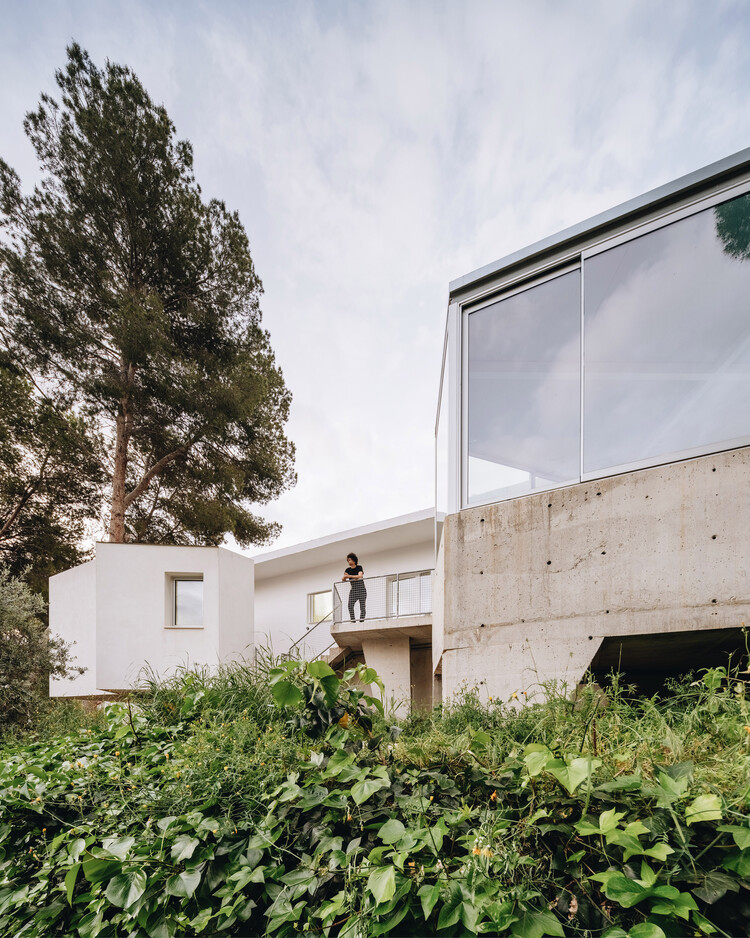
Although exposed internally, the timber is concealed externally behind pale grey cladding panels. Here, the walk-in wardrobe is the focal point.
While most of the house is contained within one compact block, this first-floor extension protrudes into a narrow gap between two neighbouring buildings. It's raised on cedar columns with concrete feet, creating a sheltered outdoor space underneath.

"By lifting the building along this strip, we created a covered pilotis that allows access from the parking area to the entrance without exposure to rain," said Iwamoto.
"By concentrating storage in the narrow strip, the remaining rooms require minimal built-in storage. This keeps the walls open and allows the expressive surfaces of the large-log timber to remain visible."

On the ground floor, the floor plan was divided into two to create a combined kitchen and dining room, and a studio that allows one of the owners to work from home.
On the first floor, the sliding bookcase walls allow for either a one-bedroom or two-bedroom arrangement.
"In Japan, young children often sleep with their parents, so separate rooms are not immediately necessary. As children grow, they require privacy, but later they may leave home," said Iwamoto.

"The sliding cabinets allow the space to expand or subdivide as the family evolves, ensuring that the house can adapt, and that the couple can reclaim generous space later in life."
Iwamoto was a partner at Vo Trong Nghia Architects before co-founding ICADA, and collaborated with the studio on House in Nha Trang. Other ICADA projects on Dezeen include Knothole House.
The photography is by Nobutada Omote.
Project credits
Architect: ICADA (Masaaki Iwamoto, Nariaki Chigusa)
Structure: Graph Studio (Mika Araki, Hirotaka Ujioka)
Energy consultant: Studio Nora (Keiichiro Taniguchi, Maki Fujimura)
Contractor: Sakaki Juken
Timber procurement: Anai Wood Factory (Shunsuke Anai)
The post Live Sawn House features moving walls and a room on stilts appeared first on Dezeen.