



‘play is my small form of resistance’: léa mestres on imagination and designing a freer world


inside léa mestres’ imaginative design world
In Léa Mestres’ universe, lamps become landscapes, benches resemble dreamlike creatures, and mosaics shape painted skies. The French artist and designer has built a practice around humor, instinct, and irreverence, pushing back against what she sees as an overly serious, and often overly masculine, design culture. Her latest exhibition, Small Car, Big Windows, presented alongside Martin Laforêt at Carpenters Workshop Gallery in London, continues that pursuit through a collection of lighting, seating, and sculptural furniture inspired by long drives between Paris and Brittany, where shifting views of northern France become imagined landscapes.
References to Antoni Gaudí, René Magritte, Windows XP’s iconic Bliss wallpaper, and Virgil Abloh’s Louis Vuitton runway appear alongside handcrafted mosaics and her signature mineral plaster, creating works that oscillate between memory, fantasy, and the everyday. Speaking with designboom, Mestres reflects on why play remains central to her practice, how intuition drives every project, and why making people smile is still her measure of success. ‘When I’m making an object, I need to have fun. If I’m not enjoying the process, then the result is never good. If something I create can make people smile, then I feel I’ve done a good job,’ the designer tells us.
Throughout her career, Mestres has described her work as a response to a design culture that often privileges seriousness over spontaneity. Today, she extends that resistance beyond design itself. ‘Play is my small form of resistance, not only against the design world, but against the world in general,’ Mestres says. ‘It offers another way of thinking, one that feels freer, lighter, and more open.’

all images by Tom Carter, unless stated otherwise
small car, big windows: northern France as imagined landscape
This attitude runs throughout Small Car, Big Windows. While Martin Laforêt translates motorway bridges, industrial structures, and concrete landscapes into restrained sculptural furniture, Léa Mestres approaches the same journeys through imagination. The exhibition takes its title from hours spent traveling across northern France, where movement became a creative framework.
‘The moving landscape was the starting point for the collection,’ the French designer explains. ‘While making the first lamp, I found myself drawn to nostalgic references such as the Windows XP wallpaper Bliss, paintings by René Magritte, and Virgil Abloh’s show for Louis Vuitton — the one featuring the sky. All of these references led me toward transforming reality into an imagined world.’

this freestanding mosaic lamp turns a grass-and-cloud landscape into light
building landscapes, one tile at a time
That imagined world comes to life through mosaic. Across large lighting sculptures, benches, and lamps, fragments of colored glass placed one next to another shape grassy fields beneath expansive skies, creating surfaces that function like paintings assembled piece by piece. The references are clear, but Mestres makes the technique her own through slow, hand-cutting each piece of glass into painterly compositions. ‘I have always been fascinated by the mosaics of Antoni Gaudí, Lluís Domènech i Montaner, and Niki de Saint Phalle,’ she shares with us. ‘I love spending hours cutting glass tiles piece by piece and watching the ”painting” slowly come to life.’
For Léa Mestres, the attraction extends beyond craftsmanship, as mosaic opens new possibilities for where her work can exist. ‘I’m interested in creating works that can exist both indoors and outdoors. The outdoor environment is something I want to explore more, creating an imaginary landscape within a real one.’

all-over grass pattern wraps the lamp
where function meets fiction
Although her objects often appear playful enough to be mistaken for sculpture alone, utility remains inseparable from her practice. Lamps still illuminate; benches remain places to sit. ‘My goal is always to create something I have imagined and bring it as close as possible to reality. When I manage to do that, I feel satisfied. Both functionality and sculpture are essential to my practice — I can’t separate them. Instead, I try to bring them together in a way that feels true to my own approach,’ she comments.
Narrative plays a similarly connective role in Mestres’ works. The pieces carry names or personalities, appearing as fictional characters inhabiting the same universe. ‘Narrative helps me create context for the work and find a sense of unity within a collection. It gives each piece a place within a larger story,’ Léa Mestres highlights.

close-up of the lamp’s rough, hand-worked blue-and-white surface
intuition, imperfection, and the next piece
That instinctive approach also shapes the way she works. The finished pieces may appear meticulously composed, though their origins are often immediate and obsessive, less driven by planning than by intuition. ‘Intuition is everything,’ she shares with designboom. ‘I follow my instinct completely. When I have an idea, I become fixated on it until I make it happen. It can be a little obsessive, actually.’
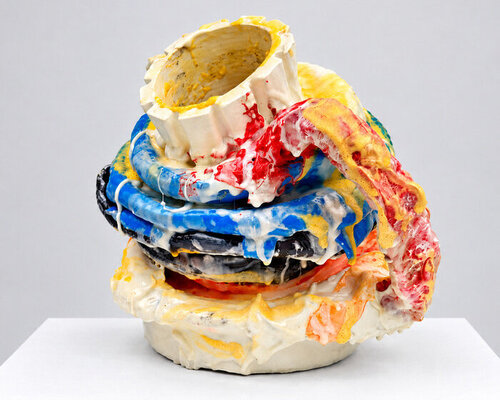
This emphasis on instinct is visible in the exhibition’s Craving for Crépi works, where Mestres embraces uneven textures, imperfect forms, and spontaneous color combinations. The works celebrate experimentation as a methodology, embracing imperfection as part of each object’s identity.
Despite the exhibition’s expansive landscapes and imagined horizons, Mestres is already looking beyond them. Asked what occupies her thoughts after Small Car, Big Windows, her answer is strikingly concise. ‘The next piece!’

individually cut glass tiles compose the mosaic surface

Mestres developed her signature lélélite plaster to celebrate texture, imperfection, and spontaneity

the mosaic composition recalls the artist’s imagined landscapes

a new lamp clad in Mestres’ signature mineral-based plaster, lélélite

the textured lighting piece recalls blue skies and drifting clouds

close-up of the lamp’s textured lélélite surface

a sculptural bench clad in hand-cut mosaic tiles

the piece depicts clouds and grassy fields

two soft, sculptural backrests complete the bench

the bench combines functional seating with anthropomorphic, rounded forms

Installation view of Small Car, Big Windows at Carpenters Workshop Gallery, London | image by Benjamin Baccarani

utility remains inseparable from Mestres’ practice | image by Benjamin Baccarani

mosaic lamps transform the gallery into a landscape of grass, clouds, and sky

Craving for Crépi celebrates texture, experimentation, and imperfection | image by Benjamin Baccarani

pink ceramic tiles punctuate the textured surface | image by Benjamin Baccarani

lighting piece from Mestres’ Craving for Crépi series | image by Benjamin Baccarani

Mestres makes the technique her own through slow, hand-cutting each piece of glass | image by Benjamin Baccarani
project info:
name: Small Car, Big Windows
artist: Léa Mestres | @leamestres
venue: Carpenters Workshop Gallery | @carpentersworkshopgallery, London
dates: June 11th – September 20th, 2026
This interview is part of designboom’s Play chapter, exploring what happens when creators prioritize emotional warmth, vibrant geometries, and tactical leisure. Discover more related stories here.
The post ‘play is my small form of resistance’: léa mestres on imagination and designing a freer world appeared first on designboom | architecture & design magazine.