SUPERFLEX and mudam invite community to rethink the bank

Luxembourg’s banks as a site for creative inquiry
Mudam Luxembourg – Musée d’Art Moderne Grand-Duc Jean, SUPERFLEX, and museum visitors have come together to create something this small European country is big on: banks. Throughout the summer of 2026, members of the community are invited to Mudam to co-create The Bank, which will result in a permanent installation for the surrounding Park Dräi Eechelen. Here, a bank isn’t merely a place to hold money—it could be a site for storing ideas, containers for critters to stow away their treasures, or a central point for collecting and distributing food. Using molds created by the Copenhagen-based artist collective, kids and curious adults will shape the exterior architecture into a site for inquisitive banking.

SUPERFLEX: The Bank at Mudam Luxembourg – Musée d’Art Moderne Grand-Duc Jean is realized with the support of the PwC Foundation Luxembourg, under the aegis of the Fondation de Luxembourg | all images Marion Dessard © Mudam Luxembourg
Curator António Mendes in conversation with designboom
‘We are in a city famous for banks, and Mudam itself can be understood as a kind of bank of culture: it preserves objects, ideas and histories that a society considers valuable, But this immediately raises more interesting questions.’ Curator António Mendes tells designboom. Alongside co-curator Christophe Gallois, the museum‘s participatory installation challenges the idea of containing. Mendes elaborates on the ideas that The Bank seeks to explore: ‘Who decides what has value? What do we choose to preserve? Who has access to it? And what are we failing to protect?’

curator António Mendes talks to designboom about banks as a site of inquiry for the Mudam project
SUPERFLEX molds start shaping the dialogue
‘SUPERFLEX transformed these questions into something physical and accessible.’ He refers to the plaster molds created for visitors to start thinking about the component parts of their creation. Using clay pressed into the negative space, they create brick-like elements in different geometric shapes that can be brought outside and formed into a ‘city of banks’ that ebbs and flows based on contributions and the effects of the natural environment. ‘Elements of Mudam’s architecture are broken down into modular forms that visitors can move, combine and rebuild. These temporary constructions become starting points for conversations about what a different kind of bank might contain and whom it might serve.’
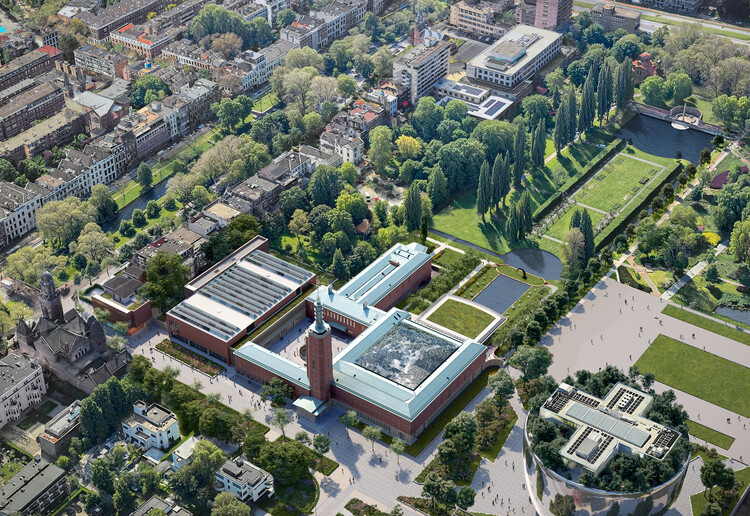
These molds are a ‘deconstruction’ of the building that houses Mudam, though Mendes is keen to point out that, ‘Practically, nobody is being invited to attack I. M. Pei’s building with a hammer.’ He describes the process of developing their shapes: ‘Elements of Mudam’s architecture have been abstracted and transformed into modular forms. Visitors can move them, rotate them, stack them and combine them in ways that the actual museum obviously does not permit. The architecture moves from the scale of the monument to the scale of the body and the hand.’

using clay molds designed by SUPERFLEX, visitors can create brick-like elements in different geometric shapes that can be brought outside and formed into a ‘city of banks’
Play’s potential to transform a bank
Watching the clay pieces get stacked and crumble, form into rings, and stack into towers shows the agency given to all age groups to create. Key to the formation of The Bank is the encouragement to play, not just with the material on the shiny orange and green modeling mats, but also with the very idea of what this structure could be. ‘Play is essential because it changes our relationship to a site. It gives people permission to touch, test, move, invent and occupy space differently. Public space is often extremely regulated and, frankly, not always designed with much joy. Play temporarily loosens those rules. Children understand this immediately. Adults sometimes need an architectural excuse. The Bank provides one.’ Mendes emphasizes.

key to the formation of The Bank is the encouragement to play, not just with the clay, but also with the very idea of what this structure could be
The multi-step development of The Bank
‘The project develops through several connected phases: the modular installation, public workshops, collective activations, written messages, informal conversations, encounters with children, families, neighbours and other groups, and eventually the development of a permanent artwork for Park Dräi Eechelen.’ On bringing SUPERFLEX into the mix, Mendes comments on their unique ability to think beyond the boundaries of art, public space, infrastructure, and generations. ‘SUPERFLEX also understands that collective authorship does not mean dissolving artistic responsibility. The permanent work will remain their artwork, but it will be informed by a much wider intelligence: the accumulated experiences, requests and imaginations of the people who participated in the process. They understand that expertise can appear in unexpected places… The best idea does not necessarily come from the person with the most impressive title. Occasionally, it might come from a fish.’

The Bank is a collaboration between SUPERFLEX, Mudam, visitors to the workshop and will be installed in Park Dräi Eechelen
From a child’s question to SUPERFLEX’s permanent installation
Since May 2026, The Bank’s builders—namely the children and adults who have activated the installation—have been in and out of Mudam. Mendes shares his observations about how different perspectives and expertise lend themselves to what is created. ‘Children often move very quickly from architecture to social organization. They do not only ask, ‘What does my building look like?’ They ask, ‘Who lives here?’, ‘Can everyone come in?’ or ‘What happens inside?’ They understand that making a place also means creating relationships and rules. Adults tend to begin by asking what they are allowed to do. Children begin by asking what is possible. After a few minutes, the adults usually join in—although with slightly worse knees and a stronger concern for structural stability.’
Although the final form will come from a design created by SUPERFLEX, the structure will hold the memory of the creation process. Mendes points out that what gives the project its richness is not the form, but the path to finding it. He describes it as: ‘A child’s construction, a request made during a workshop, a message left behind, or a disagreement during a discussion may each reveal something important. No single contribution will dictate the final form, but together they create a richer and more complex understanding of what the space could become.’

Mendes points out that what gives the project its richness is not the form, but the path to finding it

‘children often move very quickly from architecture to social organization,’ notes Mendes on what he’s observed in visitor participation

a bank isn’t merely a place to hold money—it could be a site for storing ideas, containers for critters to stow away their treasures, or a central point for collecting and distributing food

the Copenhagen-based artist collective will create the final form based on the participatory process that has taken place over the summer months
project info:
name: The Bank
curators: António Mendes and Christophe Gallois, assisted by Clara Froumenty
collaborator: SUPERFLEX |@superflexstudio
location: Mudam Luxembourg – Musée d’Art Moderne Grand-Duc Jean | @mudamlux
This interview is part of designboom’s PLAY chapter, exploring what would happen if form didn’t follow function, but pleasure. Discover more stories that celebrate joy, imagination and playfulness here.
The post SUPERFLEX and mudam invite community to rethink the bank appeared first on designboom | architecture & design magazine.