




Ten items from the Zaha Hadid archives that capture her talent and idiosyncrasies



Today marks 10 years since the death of one of architecture's all-time greats, Zaha Hadid. To help mark the anniversary, Zaha Hadid Foundation director Aric Chen has picked out 10 of his favourite items from the Hadid archive exclusively for Dezeen.
Iraqi-British architect Hadid died from a sudden heart attack in Miami on 31 March 2016.
Sometimes referred to as the "Queen of the Curve", her distinctive style had an enormous impact on the way buildings are designed. She is still the only solo woman ever to win the coveted Pritzker Architecture Prize, receiving the honour in 2004.
Today her legacy is looked after by the Zaha Hadid Foundation, which this summer will be carrying out renovation works on its 10 Bowling Green Lane building in London – Hadid's former office – with plans to reopen in the autumn as a public space hosting exhibitions, talks, workshops and other cultural events.
The charity is also currently undertaking a multi-year project to inventory and catalogue the estimated 300,000 items in its archive.
In memory of Hadid on the 10th anniversary of her death, foundation director Chen selected 10 artefacts for Dezeen:

Malevich's Tektonik, London, UK, 1976
"This student work of Zaha's is something we always bring out for visitors to the archive. It speaks of her precociously bold inventiveness, and the influence of Malevich and the 20th-century Russian and Soviet avant-garde on her pursuit of liberating architecture from constraints, and even gravity, through abstraction.
"In this case, Zaha was responding to an assignment while studying under Rem Koolhaas and Elia Zenghelis at the Architectural Association (AA). Based on one of Malevich's 'arkhitekton' studies of architectural form, you can see what would become a 14-storey hotel orbiting and landing on London's Hungerford Bridge.
"Zaha would create new versions of this painting later on, but this is the first, and was presumed lost until we rediscovered it in one of her student portfolios."

Student sketchbook, London, UK, 1977
"Among the dozens of sketchbooks in the archive, three of them, including this one, cover the period from October 1976 to May 1977 when Zaha was a student at the AA. Together, they offer remarkable insights into the development of her ideas, while posing just as many questions.
"This particular drawing relates to the development of her student project for a Museum of the Nineteenth Century, and comes towards the end of a series that places its elements in a range of sites and locations including, as you can see, her native Iraq. We're not exactly sure what her intentions were in doing this, but we're often asked how closely connected Zaha felt to Iraq, and the answer is: very.
"It will be exciting to see her only built project in the country, the 170 metre-tall Central Bank of Iraq tower, inaugurated later this year."

The Peak, Overall Isometric, Day View, Hong Kong, China, 1983
"Zaha found conventional methods of architectural drawing to be limiting, and so – especially early on – she used painting as a tool for investigating new possibilities for architecture, tectonics and space. We're fortunate to have hundreds of these paintings in the archive.
"This one depicts her proposal for a leisure club on Hong Kong's Peak that won an international competition in 1983. While it was ultimately never built, the scheme caused quite a stir and helped catapult Zaha to the forefront of the architectural vanguard at the time."

Painted Jacket, circa 1985
"Zaha was as virtuosic in constructing her persona as she was in creating architecture. In many ways, her work, how she lived and who she was were of a piece, and fashion – what she herself wore –figured prominently into the equation.
"The archive includes her personal wardrobe: around 1,200 garments including extraordinary examples from Issey Miyake, Yohji Yamamoto, Comme des Garcons, Prada.
"However, Zaha herself designed and made this linen jacket in the mid-1980s, painting it with the same 'wooshes' and other shapes that can be found in some of her sketchbooks and interior designs of the period. It also reveals her playful side: tucked in a lower corner is a single, large googly eye.
"She wore the jacket to the opening of her first solo exhibition in Japan at the GA Gallery in 1985."

Vitra Fire Station presentation box, Weil am Rhein, Germany, 1991-1993
"For years, it was assumed that Zaha's designs were unbuildable, until she started building them. Her first permanent structure was a fire station commissioned by Rolf Fehlbaum for the Vitra Campus in Weil-am-Rhein, Germany.
"Made for that project, this incredible acrylic box model snugly fits layers of cardstock reliefs, paintings, drawings and photocopies in a way that allowed Zaha to literally carry the design process with her to client meetings.
"The office made several of these for various projects. In a 1993 lecture, Zaha described how, being an Iraqi passport holder at the time, she would often get stopped at the airport. And so making these transparent, see-through cases was a somewhat cheeky way of speeding up the baggage-search process."

A New Barcelona sketches on Post-its, 1989
"The design process in the office could be both brisk and iterative, and Zaha often used Post-its, alongside sheets of tracing paper, notepads and hotel stationery, to communicate intentions, assign tasks, jot notes, or spark design concepts amongst her staff and colleagues.
"This set of early sketches, relating to A New Barcelona (1989), her entry to a competition called Housing and the City, explores interlocking geometries that twist the city's axis and probe the layering of elements within Barcelona's grid."

Music Video Pavilion study models, Groningen, the Netherlands, 1990
"The archive includes countless architectural models, but I have a particular weakness for these little guys, which were made by the artist Daniel Chadwick while he was working for Zaha.
"They're variations on a music video pavilion that Zaha built for a 1990 urban festival in Groningen, the Netherlands. (Bernard Tschumi, Rem Koolhaas, Peter Eisenman, and Coop Himmelb(l)au also participated with pavilions of their own.)
"Zaha's narrow pavilion, wedged between two historic buildings, led visitors up stairs and ramps through a series of screened music videos – a new pop-culture medium at the time. The pavilion still exists, though moved to another location, and will feature in our exhibition Zaha Hadid: Architecture of Performance, which will be on view at the foundation when we reopen this autumn."

MAXXI relief model, Rome, Italy, circa 1998
"How to represent Zaha's unconventional spatial imagination was a constant question for the office, and one of the most striking inventions they came up with was paper reliefs, like this one for the MAXXI museum in Rome.
"Cut and folded from single sheets of heavy paper, these reliefs bridged Zaha's 2D and 3D work while articulating the interlocking forms and flowing spaces she was exploring and, in this case, their relationship to the museum's urban site."

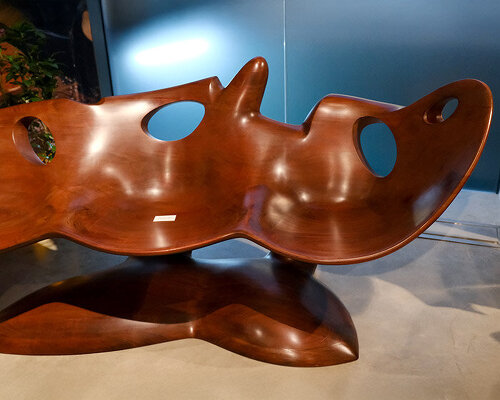
Liquid Glacial Dining Table, London, UK, 2012
"In some quarters, Zaha is known just as much for the objects she designed as her architecture. By all accounts, she was passionate about the many furniture, tableware, jewellery and other objects that she and her studio created with over a hundred manufacturers and producers.
"One of the projects I remember best is the Liquid Glacial collection she designed for David Gill Galleries in London, including this stunning two-part dining table, which sits in the archive with its pulsating, rippling surface."

Wooden Goat, date unknown
"Zaha mostly furnished her homes with her own designs, but with some notable exceptions. She was a fan of the Panton chair, for example. And then there was this goat.
"We're still looking into the backstory, but it became something of an old standby for her, and an emblem of the deep loyalty that defined many of her relationships.
"As a 2008 Vogue magazine profile on Zaha's home reported: 'The only animal is a carved goat which a friend gave her years ago and which she takes everywhere because, as she says, 'I am very superstitious about friendship'."
The images are courtesy of the Zaha Hadid Foundation.
The post Ten items from the Zaha Hadid archives that capture her talent and idiosyncrasies appeared first on Dezeen.