





india pavilion at venice biennale reflects on how craft keeps the idea of home alive


materials become vessels of memory at the India Pavilion
The India Pavilion at the 61st International Art Exhibition of La Biennale di Venezia turns to some of the country’s oldest materials to address the experience of distance. Titled Geographies of Distance: remembering home, the exhibition brings together artists Alwar Balasubramaniam, Sumakshi Singh, Ranjani Shettar, Skarma Sonam Tashi, and Asim Waqif, whose works transform earth, thread, bamboo, natural fibers, and papier-mâché into reflections on memory, migration, belonging, and change (find designboom’s previous coverage here)
Within the Arsenale’s Isolotto, fractured landscapes, suspended structures, vernacular dwellings, and evolving frameworks shape the exhibition. The ensemble of the works suggests that home is something continually reconstructed through memory, ritual, and making. For curator Amin Jaffer, craft became the conceptual and material foundation of the project.
‘Firstly, I felt that the materials used in the Pavilion should themselves evoke home,’ Jaffer tells designboom. ‘The choice of materials — earth, thread, cloth, bamboo, papier-mâché — is significant because they play a role in Indian culture, design and decorative arts.’

Under the same sky, Ranjani Shettar | all images by Joe Habben, unless stated otherwise
craft as an archive of belonging
Apart from presenting craft as heritage alone, the pavilion positions material knowledge as a living archive capable of carrying personal and collective histories across generations. Each artist draws from materials rooted in everyday Indian life, using them to consider how home is remembered when places transform, disappear, or become increasingly distant. ‘Materiality plays a central role in the project,’ Jaffer explains. ‘I very much wanted visitors to the Pavilion to understand that the five artworks are not just made of Indian materials, but of materials that have a deep significance in Indian civilisation and identity.’
Home appears in multiple forms in the India Pavilion exhibition, through cracked earth and remembered architecture, through suspended gardens and fragile settlements, and through scaffolding that points toward an uncertain future. Visitors encounter home as a collection of fragments. ‘Within the pavilion, each work contributes to a landscape in which home is fractured, suspended or unstable,’ says the curator. ‘Visitors move between different manifestations of home: the fractured ground beneath our feet, the fragmented thread house, immersive suspended garden, the cluster of vernacular houses — and finally the bamboo scaffolding which symbolizes change.’

Under the same sky, Ranjani Shettar | image © Andrea Avezzù
rebuilding a vanished house with thread
In Permanent Address, Sumakshi Singh reconstructs fragments of her demolished family home in New Delhi using delicate white thread. Once inhabited by five generations, the house survives today only through memory. ‘In Permanent Address, viewers walk through life-sized fragments of my demolished family home created entirely in translucent, white thread,’ Singh tells us. ‘Built by my grandparents in New Delhi and lived in by five generations, the house now survives only in memory.’
Replacing brick and mortar with translucent stitched surfaces, the installation transforms architecture into an apparition. The work draws on embroidery traditions passed through generations of women, asking what remains when the physical markers of home disappear. ‘Home is an anchor — already lost to many,’ the artist reflects. ‘This work sits in that loss and in the enduring human need for safety, belonging, and a place to call home.’

India Pavilion at the 61st International Art Exhibition of La Biennale di Venezia
earth, memory, and natural forces
Through his contribution to the exhibition, artist Alwar Balasubramaniam turns to the ground itself. His monumental earthworks take shape through the bonding and separation of soil and water, allowing natural forces to actively participate in the making process. ‘Not just for us, artwork is made in a collaboration with natural forces,’ shares Balasubramaniam. ‘Through a process of bonding and separating earth and water, a cracked surface emerges, one that reflects both material behavior, the changes in the environment and a sense of our own fragmentation.’ The artist allows the material itself to carry traces of time, erosion, and continuity.
For Ranjani Shettar, home emerges through the engagement with nature and handmade processes. Her installation, ‘Under the same sky’, assembles handwoven cotton, steel, and lacquer into a hovering installation. ‘My work, ”Under the same sky”, brings together strands of my practice from across the years,’ Shettar explains. ‘I am interested in how form, space, and material come together to create a sense of balance and tension.’
Suspended above visitors, the work extends the artist’s long-standing dialogue with natural forms while preserving a slower rhythm of making at a moment defined by speed and automation.

Permanent Address, Sumakshi Singh
fragile architectures of the himalayas
Skarma Sonam Tashi approaches home through the lens of Ladakh’s mountain landscapes and vernacular architecture. Constructed from recycled papier-mâché, clay, and cardboard, Echoes of Home, a work positioned on the mezzanine of the pavilion, recreates clusters of dwellings that appear familiar.‘My work is the outcome of my close understanding of the vast and extreme mountain landscapes of my hometown, Ladakh,’ notes Tashi. ‘Working with recycled materials enables me to evoke both the sustainability of traditional Ladakhi architecture and the fragility of its ecosystem.’
The installation reflects on the gradual disappearance of traditional building practices under the pressures of modernization and climate change. Here, craft becomes a means of preserving forms of knowledge that are increasingly at risk of being forgotten.

Chaal, Asim Waqif
bamboo scaffolding as a structure in transition
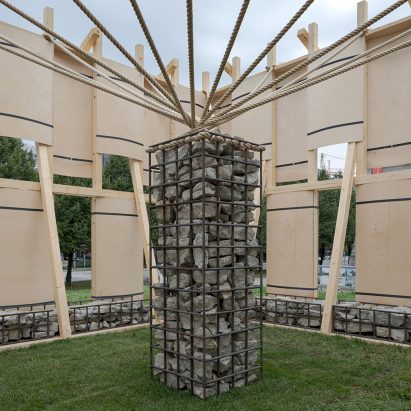
The exhibition takes a more forward-looking turn with Asim Waqif’s monumental bamboo installation. Towering above the surrounding works, the structure brings together traditional building knowledge and the realities of India’s rapidly changing urban landscape.‘The bamboo structure I will build on site in the Pavilion occupies the threshold between ancestral knowledge systems and present-day building regulations in the ongoing construction of India’s cities, towns, and villages,’ Waqif describes.
Using a material associated with informal construction and vernacular architecture, the artist transforms scaffolding into a symbol of perpetual transition. Neither complete nor permanent, the structure embodies a condition of becoming. For Jaffer, the work introduces a crucial shift within the exhibition’s broader narrative. While several projects look toward memory and loss, Waqif’s installation gestures toward future possibilities. ‘The pavilion reveals an India that is deeply rooted in its material culture, but which is contemporary in its vision and expression,’ the curator says. ‘While the projects of Bala, Sumakshi, Ranjani and Tashi reflect a remembrance of home as it was, Asim’s soaring bamboo scaffolding shows how India moves into the future with dynamism and positivity.’

Chaal, Asim Waqif
carrying home across distance
Beyond the exhibition space, the India Pavilion presents a program of performances, sound pieces, and temporary interventions staged across Venice. Appearing briefly throughout the city, these events echo the exhibition’s broader exploration of home as something that is carried through memories and shared experiences. ‘The expanded program allows the pavilion’s ideas to move beyond the exhibition space and enter the lived fabric of Venice,’ Jaffer notes. ‘Home is not fixed, but experienced fleetingly, through memory and encounter.’
Through earth, thread, bamboo, and recycled matter, Geographies of Distance: remembering home proposes that craft is a way of carrying knowledge across generations, sustaining cultural memory through periods of transformation, and reconstructing a sense of belonging when geography alone is no longer enough.

Echoes of Home, Skarma Sonam Tashi | image © Andrea Avezzù

Echoes of Home, Skarma Sonam Tashi[ | image © Andrea Avezzù/dbcosmo_fullwidth_image]
[caption id="attachment_1194772" align="alignnone" width="818"] Not Just for Us, Alwar Balasubramaniam (Bala)[/caption]
[dbcosmo_fullwidth_image src="https://www.designboom.com/wp-content/uploads/2026/06/india-pavilion-venice-biennale-2026-craft-idea-home-alive-interview-designboom-large01.jpg" width="1800" height="1200" image_title="india-pavilion-venice-biennale-2026-craft-idea-home-alive-interview-designboom-large01"]Not Just for Us, Alwar Balasubramaniam (Bala) | image © Andrea Avezzù

Ranjani Shettar, Asim Waqif, Sumakshi Singh, Skarma Sonam Tashi, curator Amin Jaffer, and Alwar Balasubramaniam (Bala) at the India Pavilion
project info:
name: Geographies of Distance: remembering home
artists: Alwar Balasubramaniam, Sumakshi Singh, Ranjani Shettar, Asim Waqif, Skarma Sonam Tashi
event: Venice Art Biennale 2026 | @labiennale
curator: Amin Jaffer
commissioner: National Gallery of Modern Art | @ngma_delhi
location: Venice, Italy
dates: May 9th – November 22nd, 2026
The post india pavilion at venice biennale reflects on how craft keeps the idea of home alive appeared first on designboom | architecture & design magazine.