









from casa malaparte to the sheats-goldstein residence, these homes became movie stars


Hollywood’s favorite architects
Some houses become famous because of the architects who designed them. Others are remembered because a film gave them a second life. Over the years, a surprising number of architect-designed homes have crossed into popular culture, becoming inseparable from the stories they helped tell. They may begin as private residences, but once they appear on screen, they often take on another identity altogether. Audiences return to them long after the credits roll, not simply because they are beautiful, but because they hold a particular mood, memory, or emotion.
Few architects have left a bigger mark on cinema than John Lautner. His houses seem almost made for the camera. Expansive glass walls, dramatic concrete roofs, and interiors that flow into the landscape create spaces that feel slightly unreal. The Sheats–Goldstein Residence in Los Angeles became instantly recognizable as Jackie Treehorn’s home in The Big Lebowski (1998), where its geometric skylights and sunken living room create an atmosphere that is equal parts glamorous and surreal. A few decades earlier, Lautner’s Elrod House in Palm Springs was chosen for Diamonds Are Forever (1971). Production designer Ken Adam reportedly looked around the house and said, ‘I don’t have to do anything.’ The architecture already embodied the futuristic world he wanted to build.

Stahl House (Case Study House #22) | image by Julius Shulman
residences that became cinematic icons
Lautner’s work keeps returning to film because it always seems to offer something beyond aesthetics. The Chemosphere, balanced on its single concrete column above Hollywood, became the mysterious home in Brian De Palma’s Body Double (1984), while the Garcia House made a brief appearance in Lethal Weapon 2 (1989). His buildings sit somewhere between fantasy and reality, making them easy to imagine as the homes of billionaires, recluses, or characters hiding something beneath the surface.
Richard Neutra’s houses tell a different story. Where Lautner’s architecture feels theatrical, Neutra’s restrained compositions often communicate calm, precision, and emotional distance. The Lovell Health House appears in both L.A. Confidential (1997) and Beginners (2010), while the Kaufmann Desert House has become one of modernism’s most photographed homes on and off screen. After inspiring countless productions for decades, the house itself finally appeared in Don’t Worry Darling (2022), where its clean lines and expansive desert setting help create an image of perfect domestic life that gradually begins to crack.
In Milan, Villa Necchi Campiglio became the backdrop to Luca Guadagnino’s I Am Love (2009), where its quiet rationalist interiors reflect the emotional restraint of the family who inhabits them. He later chose Villa Albergoni for Call Me By Your Name (2017), allowing the house to become part of the rhythm of a long Italian summer. Every corridor, staircase, and shaded garden feels lived in. Decades earlier, Jean-Luc Godard transformed Casa Malaparte on Capri into one of cinema’s most unforgettable settings in Le Mépris (1963). Suspended between sea and sky, the house expresses as much about the film’s emotional tension as any dialogue ever could.
Some houses become so familiar on screen that they almost stop belonging to architecture alone. Pierre Koenig’s Stahl House is one of them. Originally built as Case Study House No. 22, it has appeared in films including Playing by Heart, Nurse Betty, and Galaxy Quest, while its image has become shorthand for Los Angeles itself. Likewise, the A. James Speyer House outside Chicago entered popular culture after Ferris Bueller’s Day Off sent a Ferrari through its glass pavilion, turning a refined modernist residence into one of the most memorable scenes in American cinema.
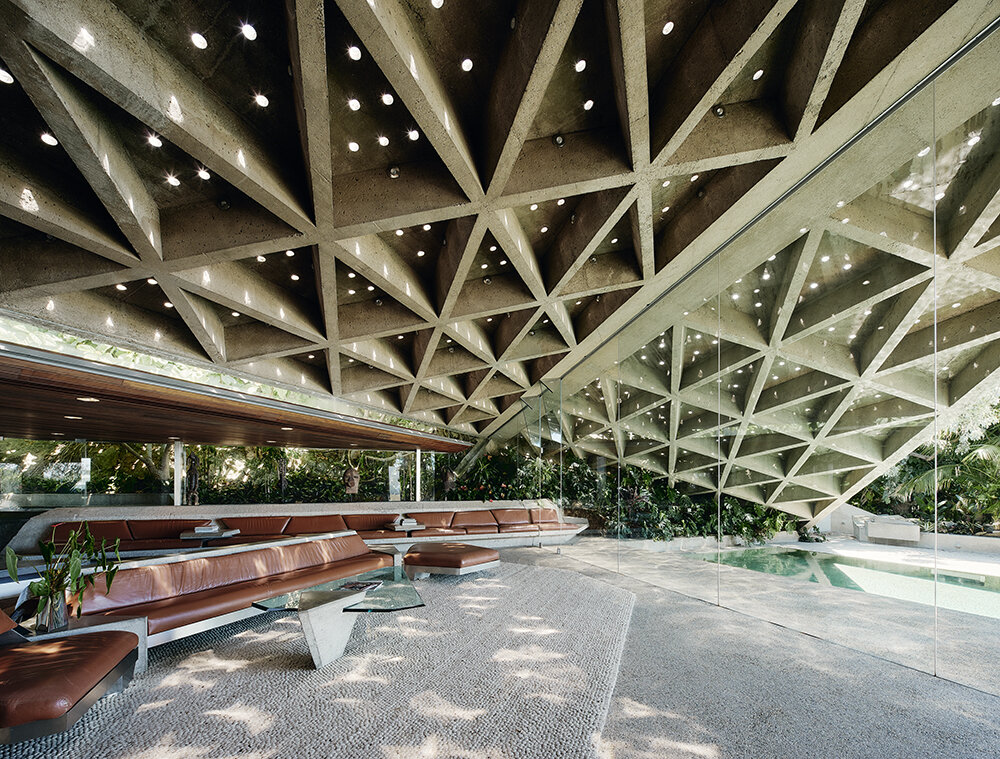
Sheats–Goldstein Residence | image © Joe Fletcher
Why modernist houses work so well on screen
Modernist houses rarely serve as neutral backgrounds. Their openness, transparency, and carefully composed geometry often become visual cues for wealth, ambition, isolation, or control. What was once imagined as an optimistic vision for modern living has frequently been reinterpreted by filmmakers as the ideal setting for villains, tech billionaires, lonely geniuses, or people living behind carefully constructed facades.
That association continues in more recent films. Alex Garland’s Ex Machina (2014) turns Norway’s Juvet Landscape Hotel into the secluded home of an AI entrepreneur. Surrounded by forests and rock formations, the architecture feels both deeply connected to nature and completely removed from everyday life. Production designer Mark Digby later explained that the team deliberately tried to move away from the familiar image of the wealthy villain’s modernist retreat, even if audiences inevitably brought those associations with them.
Glass Onion (2022) plays with similar ideas. Edward Tuttle’s Amanzoe resort in Greece becomes the extravagant island compound of a technology billionaire, where monumental colonnades, endless pools, and carefully framed views mirror the excess and performance of its owner.
Production designers often speak about searching for buildings that already contain the emotional qualities a script requires. For Don’t Worry Darling, Katie Byron described looking for spaces that conveyed idealized wealth before allowing subtle feelings of unease to emerge. The location team behind The Big Lebowski reportedly kept returning to Lautner’s Sheats–Goldstein Residence because no other house created quite the same atmosphere. Architecture already carries its own narrative, and filmmakers recognize it.

Edward Tuttle’s Amanzoe resort in Greece | image by Pygmalion Karatzas
When a film changes a building’s legacy
Cinema, in return, reshapes the lives of these buildings. Some are now known as much for their film appearances as for their architectural significance. Casa Malaparte has become inseparable from Le Mépris. The Stahl House owes part of its international recognition to decades of appearances on screen. The Ben Rose House found renewed public attention after Ferris Bueller’s Day Off, helping fuel preservation efforts years later. Film gives these houses another history, one that often reaches audiences far beyond architecture.
Perhaps that is why these buildings continue to fascinate us. A house can shape the way a story feels without demanding attention for itself. Sometimes it reflects the inner life of a character. Sometimes it creates tension before anything has happened. Sometimes it simply stays with us long after the film ends.
The most memorable movie houses become memorable because they become part of the storytelling. Like the best supporting actors, they never steal the scene, yet somehow the film would not feel the same without them.

Casa Malaparte, Capri, Italy, 2019 | image by Sebastiano Pellion di Persano

Sheats–Goldstein Residence | image © artjocks

Juvet Landscape Hotel | image via @juvetlandscapehotel

Chemosphere | image via LA Conservancy

Edgar Kaufmann House | image Shulman Photo Archive Getty Research Institute

Villa Necchi Campiglio | image via FAI
This article is part of designboom’s MODES OF HABITATION chapter, exploring how the spaces we inhabit can reshape the ways we live together. Discover more stories rethinking domesticity, shared living, and the many forms a home can take here.
The post from casa malaparte to the sheats-goldstein residence, these homes became movie stars appeared first on designboom | architecture & design magazine.