






oorvi sharma believes craftsmanship is key to building resilient futures


Why Craft Endures
If it is to endure, craft must be understood not as a remnant of the past but as a methodology for building resilient futures. Craft knowledge is too often framed as heritage: a repository of techniques to be documented, preserved, or nostalgically revisited. Such a reading fundamentally underestimates its contemporary significance. Craft is not valuable because it has survived; it has survived because it has remained valuable.
Resilience can be understood as the capacity to metabolise disruption – economic, climatic, technological – while remaining socially, materially, and culturally rooted. By this measure, craft stands among the most enduring knowledge systems. Its longevity is evidence of continuous recalibration across generations, where it evolves through intimate dialogue between material, climate, labour, ecology, and community. Unlike products designed for rapid obsolescence, craft knowledge evolves through long temporal cycles, where refinement occurs over decades or centuries rather than through the cadence of annually-programmed, financial calendars.
Between craftspeople and institutions, frictions emerge around ephemerality, event-making, capital allocation, and the valuation of labor. Yet in my own work – spanning exhibitions, heritage contexts, and cultural commissions – it is precisely these opportunities within institutional frameworks which have the potential to reveal the continued relevance of craft. In an era captivated by acceleration, optimization, and the ephemerality of products, embodied making offers an alternative proposition. It reminds us that endurance is a necessary measure in processes of innovation: the ideas that persist are rarely those that resist change; they are those that evolve while remaining accountable to place, people, and material realities.

behind the scenes preparation for the Parisian presentation of the LVMH Métiers d’Art 9th Résidence Artistique 2025 | image by Oorvi Sharma
from heritage to method
Globally, the informal handworker economy is estimated to encompass some 45 million people: as estimated by the International Labour Organization, upwards of 300 million work from home in primarily craft-based handwork with the vast majority of them women, contributing hundreds of billions of dollars in value to global GDP while remaining largely without social protections.
Yet despite recurring justifications for the holistic contributions of craftsmanship within increasingly verticalised models of production, artisanal knowledge remains trapped within narrow economic and cultural categories. It is often reduced to heritage, artisanal markets, luxury commodities, or objects of nostalgia. The Aspen Institute’s Artisan Alliance has observed that artisan businesses are seldom recognised as drivers of economic growth, despite the sector’s global weight. New possibilities are emerging as endangered craft traditions and generational houses of making are reconfigured through métiers frameworks supported by cultural foundations and by luxury conglomerates: through le19M, Chanel has sought to consolidate and invest in contemporary savoir-faire, bringing together specialist métiers under a shared institutional framework that supports the transmission, visibility, and continued evolution of artisanal knowledge, with LVMH’s Métiers d’Art pursuing a parallel consolidation of savoir-faire. However, these remain systemic flourishes rather than structural shifts; they operate at the level of programme and patronage rather than reorganising how value flows through supply chains at large.
The marginalisation of craft is therefore not intrinsic to the discipline itself; it is produced by the systems through which value is recognised and distributed. The challenge is not to preserve craft as a static tradition, but to reposition craft knowledge as an active methodology for generating resilient futures – which means moving the site of intervention from the artisan to the institution. Institutions can move beyond treating craftsmanship as symbolic heritage by embedding specialist savoir-faire within contemporary systems of design, research, and production, allowing artisanal knowledge to remain an active participant in shaping culture rather than merely representing it. My own curatorial and spatial practice has tested this repositioning at the scale of exhibitions and buildings, and from that testing, three propositions emerge.

behind the scenes preparation for the Parisian presentation of the LVMH Métiers d’Art 9th Résidence Artistique 2025 | image by Oorvi Sharma
Craft as Collaborative Infrastructure
The first proposition requires a shift in how value produced through making is perceived. Meaningful evolution exists at the intersection of three step-wise conditions: collaboration across trades, the identification of disciplinary voids, and the integration of embodied craft knowledge. Each depends on the last: makers, designers, and institutions must work in the same process rather than in sequence; that proximity reveals the problems no single profession can address alone; and craft knowledge becomes the means by which those problems are answered, not an ornament applied after the fact. When the three align, the artisan is no longer a subcontractor but infrastructure. The Parisian presentation of the LVMH Métiers d’Art 9th Résidence Artistique tested exactly this alignment.
In this exhibition, held at La Main, the headquarters of LVMH Métiers d’Art, craftsmanship sat at the centre of both the exhibition and the residency. The goal was to mediate material research on denim fabric into spatial and narrative form: the work of artist Shu Yonezawa, developed in collaboration with denim artisans in Okayama, Japan, with the curatorial and scenographic direction developed in response to the material research. Spanning between the Okayama production and the Parisian presentation, the project made visible the frictions between storytelling, institutional frameworks, and the competing pace of production and presentation, particularly in relation to temporary exhibition-making and fashion installations within large institutions. In this scenario, it was the project’s commitment to a craftsmanship-first mindset that shaped its outcome: the stories of the craftsmen were spotlighted as content in their own right, given spatial presence within the red Matériothèque of La Main as the metaphorical heart of the exhibition, while modular showcase elements made the case for reusable construction over single-use scenography.

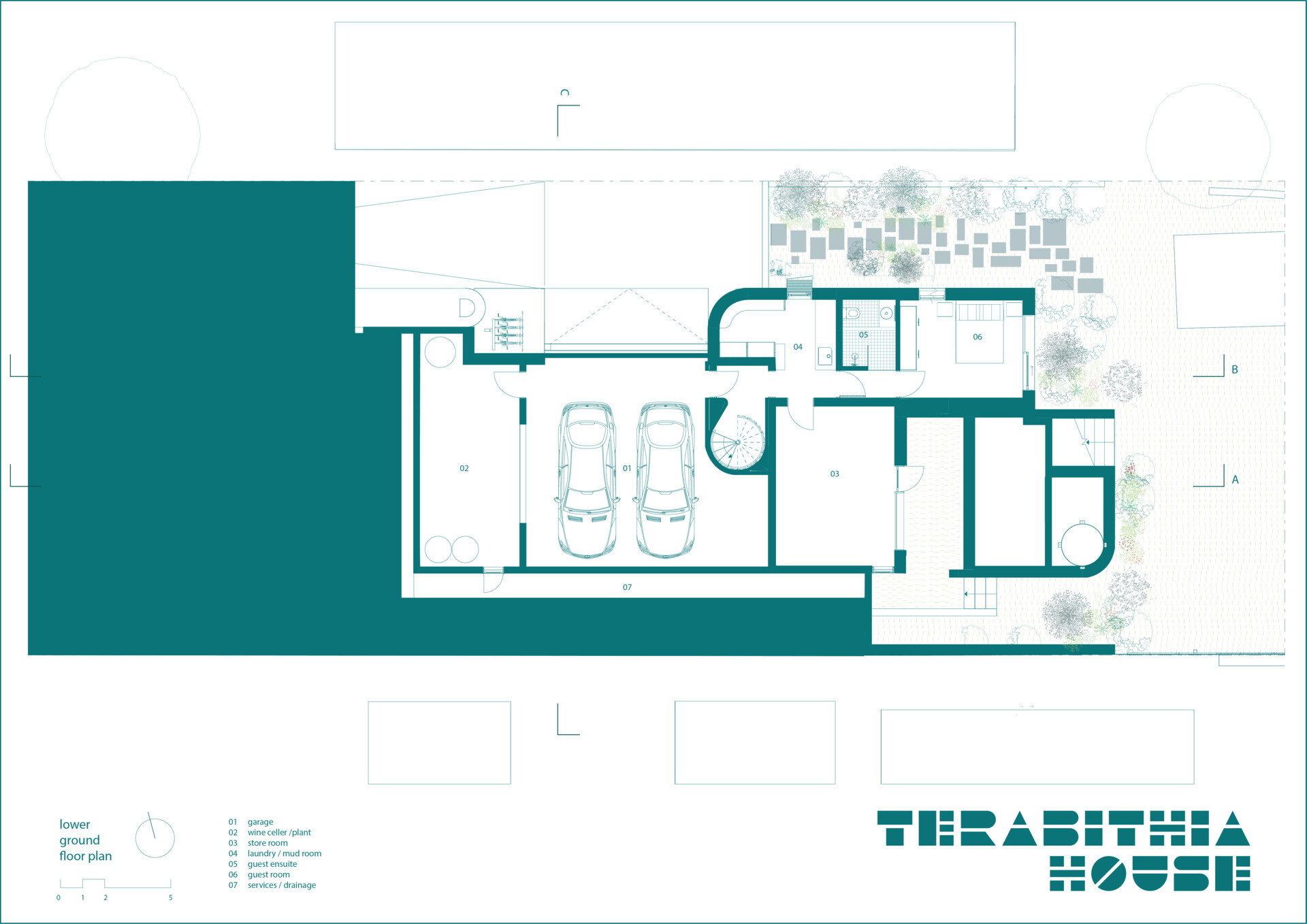
exhibition floorplan for the Matériauthèque from Parisian presentation of the LVMH Métiers d’Art 9th Résidence Artistique 2025 | drawing by Oorvi Sharma
making knowledge visible
Those stories were not decoration; they were the connective tissue of the project, and each contribution shaped the works in a distinct way. HOWA, the denim processing company credited with developing the stone-wash technique, lent its laser machinery, allowing technique to be superimposed on technique and pushing the fabric beyond its familiar registers. Miki Embroidery opened its colour archives, and its embroiderers answered the artist’s imagery with ingenuity of their own, lifting threads into tactile, sensory relief and rendering details with an intricacy only practised hands could achieve. KUROKI provided the denim that became the foundation of the works. Each of these exchanges reveals how the collaboration made legible the depth, texture, and layered processes of the material, and with them the communities and people who bring it to life. The exhibition became, in effect, an infrastructure through which their knowledge travelled from Okayama to Paris, held and displayed in a sub-floor space at La Main described as the Matériothèque.
One underlying cause of artisanal precarity is the limited ability of many makers to innovate and adapt to changing economic conditions in isolation. But this seemingly intractable condition shifts when curators, designers, and cultural institutions embed the work of craftspeople structurally – when artisanal contributions are integrated into the very logic of a project such that they cannot be removed, substituted, or retroactively mass-manufactured without the project collapsing.
In the LVMH Métiers d’Art 9th Résidence Artistique presentation, the artisanal collaborators were co-authors of the exhibition’s intelligence and it took a curatorial and scenographic vision to make that co-authorship legible. Storytelling of this kind fortifies the craftsmanship element of cultural production, and in doing so redistributes authorship and recurring economic participation. Conversely, when institutions remain at the scale of nostalgia projects – the heritage showcase, the commemorative commission – they perpetuate the very neglect that verticalised models of making have inflicted on informal manufacturing sectors. The nostalgia register flatters the artisan while confirming their marginality; it deepens rather than resolves the structural challenge.
Even where schemes exist to support artisans, implementation frequently fails to account for dire economic realities and scaled barriers to accessing meaningful work. Benefits are diluted through bureaucratic mediation, and artisanal knowledge is stalled in its evolution, in design, in institutions, and within makers’ own communities, because the broad perspective of its value is fragmented rather than held whole.

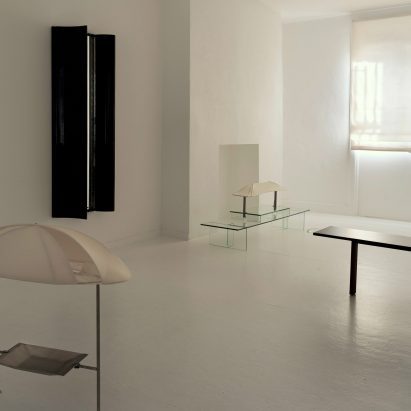
exhibition image from Parisian presentation of the LVMH Métiers d’Art 9th Résidence Artistique 2025 | image by Oorvi Sharma
an Alternative Measure of Value
Embodied making introduces criteria largely absent within purely verticalized models of production: adaptability, environmental responsiveness, and collective ownership. These criteria carry ripple effects into the domain of community, dignity, and equity, exceeding solely economic returns. The trajectory of contemporary making paradigms follows a prevailing logic based in compression: costs reduced and reduced so that profit margins can grow, with supply chains verticalised to serve that arithmetic. Within this model, craftsmanship is not eliminated; it is rationed.
As such, the introduction of the craft model prompts designers, producers, and clients to think differently about problem-solving. With no single approach sufficient for addressing intractable problems, future models of cultural success will require a broader-based approach that moves beyond restricting solutions to policy alone or economics alone. The Limits of Markets framework, popularized through the writing of Michael J. Sandel, helps to contextualize solutions that embed the holistic amelioration principles of craft, advocating for tangible interventions that shape human society and identity beyond considering products as exercises in efficiency. The value of artisanal knowledge – in transmission, dignity, and cultural identity – exceeds schedule or balance sheet logic constraints. This perspective is particularly relevant when considering approaches to support craftspeople, where economic solutions cannot be separated from social and cultural realities. It is thus key to introduce models through which institutional change in processes of economic and social upliftment becomes structural.

behind the scenes preparation for the Miqnaş pavilion and exhibition for ADIHEX 2025 | image by Oorvi Sharma
Building Different Economies
What such a model looks like in practice can be traced through Miqnaş, a pavilion realised in Abu Dhabi in which the alternative measures of value described above were tested at the scale of construction. At the centre of the pavilion was a research-based approach to building, shaped by the craft practices of artisans working in Abu Dhabi within their homes. Here the informal handworker economy described at the opening of this essay was not an abstraction but a construction partner: utilising a community network of craftswomen enabled by the Department of Economic Development and the Abu Dhabi Register of Artisans, the project found grounding in a sculpted floor made from woven khoos, palm leaves that are hydrated and braided to create rounded sarood. What followed was a collaborative process to create pigmented and designed elements, integrating knowledge of the craft into the structure with care. When the floor was finally assembled, entirely handmade, it shared with a wider public a reverence for materiality, the embedded craft, a connection to historical narratives, and an attention to domestic spaces. Visitors acknowledged this instinctively: many paused at the pavilion’s edge, remarking on the composition and recognizing the labour held within the weave before stepping onto it.
Where the compressed logic of verticalised production measures a floor in cost per square metre, Miqnaş measured it in livelihoods engaged, techniques transmitted, and material prepared for multiple reuses. In this way, the temporary platform assumes a pedagogical role in shaping approaches to design and material culture, grounded in region-specific narratives that carry material histories and craft techniques, and reinforcing the argument that temporary platforms can operate through continuity in narrative and implementation, rather than single-use disposability.

behind the scenes preparation for the Miqnaş pavilion and exhibition for ADIHEX 2025 | image by Oorvi Sharma
an Ecology of Resilience
Rather than asking how to produce more, the methodology of making described here – the embedding of artisanal knowledge within exhibitions, heritage sites, and cultural projects – asks how to produce well enough that the entire ecology of making remains alive. The value of a crafted element extends beyond its immediate function into the networks it sustains: local knowledge, apprenticeship, material economies, repair cultures, and intergenerational transmission. The objective is not simply the creation of a good product, but the maintenance of a healthy food chain of making.
Yet this ecology remains under pressure. In the context of Global South production chains, many artisanal communities are plagued by inadequate government support, low levels of literacy and awareness among artisans, the proliferation of intermediaries, and the influx of cheaper mass-produced goods with many makers reduced to precarious livelihoods. The attrition is measurable: according to United Nations estimates cited in Dasra’s Crafting a Livelihood report, the number of Indian artisans declined by thirty percent over three decades, as makers abandoned their trades for low-skilled urban employment. The structure of the market compounds the loss. With insufficient capital to procure raw materials independently, artisans often depend on middlemen for contracts, while intermediaries capture a disproportionate share of the value created through artisanal labour. Closer to home, organisations like Sharjah’s Irthi Contemporary Crafts Council have emerged precisely in response to this condition, building what the council describes as a valued artisan economy – training and upskilling women artisans so that endangered techniques translate into sustainable livelihoods rather than museum memory.
Addressing this issue is therefore not only a question of income generation, but of safeguarding dignity, cultural identity, and social participation. This is exactly the terrain on which the Limits of Markets argument converges with my own curatorial and spatial practice of embedding craftspeople deeply within projects at the scale of exhibitions and buildings. If the knowledge held in craft is a moral and civic good, and if embedding can translate that good into economic reinforcement within the food chain of making, then projects which foreground craftspeople – as the Parisian presentation of the LVMH Métiers d’Art 9th Résidence Artistique did – are not acts of generosity but corrections to a mispriced system of value.

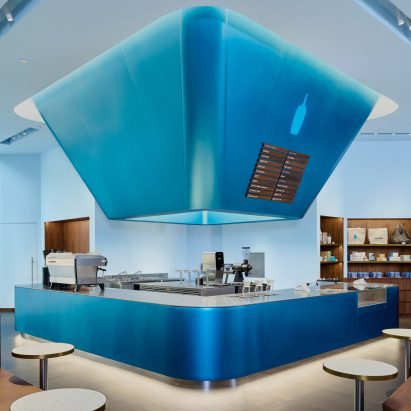
exhibition image from Parisian presentation of the LVMH Métiers d’Art 9th Résidence Artistique 2025 | image by Oorvi Sharma
From Preservation to Participation
It falls, then, to curators, designers, architects, and professionals working in culture to establish the modus operandi for craft-based projects: to return to the first proposition and treat it as a professional obligation rather than a preference. This means working interdisciplinarily and across scales, so that craft contribution is designed into the structural logic of an intervention from its inception. It means working with craftspeople directly, not through layers of intermediaries who capture value, but through relationships in which welfare, credit, and continuity become systemic elements of the project itself: authorship, fair compensation, knowledge exchange in both directions, and commissions structured so that the artisan’s participation persists.
The stakes move beyond sentiment. They are measured in the tens of millions of handworkers whose livelihoods hang on whether their knowledge is embedded or extracted, and in the resilience of a making ecology that, once broken, no verticalised system can reconstitute. If craft is to build resilient futures, it will be because curators, architects, designers, and institutions chose to build and storytell with it – deeply and structurally.

exhibition image from Parisian presentation of the LVMH Métiers d’Art 9th Résidence Artistique 2025 | image courtesy Little Shao

exhibition image from Parisian presentation of the LVMH Métiers d’Art 9th Résidence Artistique 2025 | image courtesy Little Shao

exhibition image from Parisian presentation of the LVMH Métiers d’Art 9th Résidence Artistique 2025 | image courtesy Little Shao

Oorvi Sharma at the Parisian presentation of the LVMH Métiers d’Art 9th Résidence Artistique 2025 | image by Oorvi Sharma

exhibition image from the Miqnaş pavilion and exhibition for ADIHEX 2025 | image by Oorvi Sharma

exhibition image from the Miqnaş pavilion and exhibition for ADIHEX 2025 | image by Oorvi Sharma

behind the scenes preparation for the Miqnaş pavilion and exhibition for ADIHEX 2025 | image by Oorvi Sharma
Oorvi Sharma is a Canadian architect, curator, and academic based in Abu Dhabi. An alumna of Harvard Graduate School of Design, she is an assistant professor of architecture at Zayed University while developing international exhibitions and serving in curatorial and acquisitions roles with the Department of Culture and Tourism Abu Dhabi. Her research and writing explore the intersections of craft, material culture, heritage, climate change, and contemporary design.
This guest essay is part of designboom’s Crafting the Future chapter, exploring what it means to be a maker in today’s world and the future of craftsmanship. Discover more related stories here.
The post oorvi sharma believes craftsmanship is key to building resilient futures appeared first on designboom | architecture & design magazine.