
















optician’s shop turned art installation satirizes bio-tracking tech at uncanny shifts

The Factory Art Installation at Uncanny Shifts
At Uncanny Shifts, an exhibition by Urbane Künste Ruhr set in reused spaces around Dortmund Train Station in Germany, Ellinor Aurora Aasgaard and Zayne Armstrong’s installation, The Factory, occupies a former optician’s shop. Walking down a street with a jazz bar, a hunting store, and a smattering of restaurants, it’s almost easy to miss the installation if it weren’t for a pile of inflatable figures pressing up against a glass case that would have formerly housed optical advertisements or product offerings. Within, a mise-en-scène emerges of a strangely ornate historic building-turned gym, bejeweled with ziplocked phones and embedded screens that lead the way into a short animated film bearing the name Charli & The Factory (2024).
In this immersive space, the duo create a hybrid video, painting, and sculptural environment that tells the story of a journalist, Charli, who is pursuing what could be a career-defining reportage on a FitWatch—a kind of bio-tracking smartwatch—that gets its users to achieve their goals no matter the cost. Aasgaard and Armstrong take us into The Factory, the gym in which the tale takes place, to consider ideas of labor, the body, and how we operate within contemporary capitalist dynamics. The artists most effectively introduce the project on their site themselves by saying: ‘Welcome to The Factory, where scandals sweat, and every step on the treadmill takes you closer to the edge.’
installation view from Uncanny Shifts, Ellinor Aurora Aasgaard & Zayne Armstrong, The Factory, 2026 | all images by Henning Rogge © Urbane Künste Ruhr unless stated otherwise
The Factory Fitness Studio
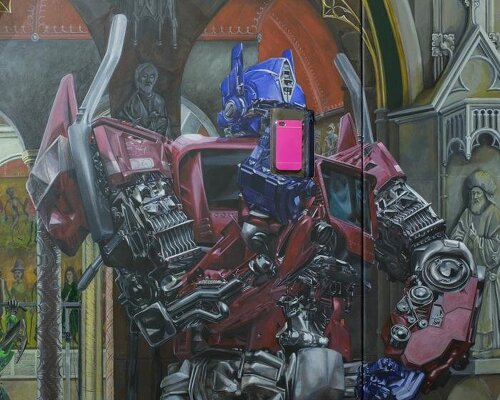
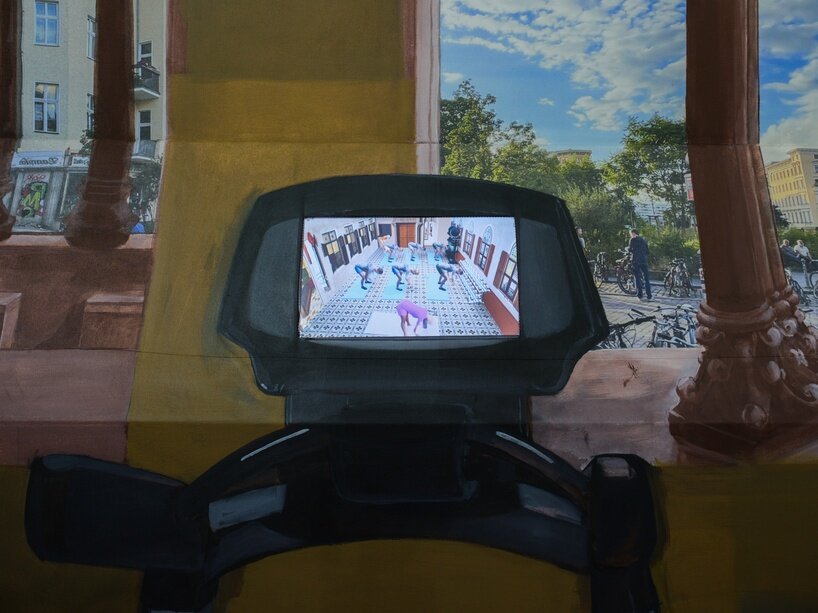
Upon entering the former optician’s shop in Dortmund, it’s difficult to quite make out what has been set in motion, as there are a whirl of figures and characters abound. Most noticeable within this scene are the painted figures of Transformers, the robots from the massively successful franchise, rendered in primary colors and luxe chromes, taking selfies with actual smartphones that are zipped up in clear baggies and embedded in cutouts within the paintings. It’s unfit, though, to call these paintings. They are more akin to the backdrops or scenics found setting the scene of a play than something found on a gallery wall. When looking closely at each panel—angled and arranged to create the artists’ medieval-gym-turned-surveillance center—one can see that the paintings are created over photos of a fairly mundane Berlin during the day.
The inside of this ‘gym’ was derived from a hodgepodge of temporally disparate paintings that range from Scenes from the Life of Saint Bertin and the Annunciation to Mary with prophets and evangelists (Simon Marmion, 1459), The Annunciation (Piero del Pollaiuolo, 1480), to Woman at a Window (Caspar David Friedrich, 1822). In this way, they evoke a kind of aesthetic and temporal weirdness that points to the strange temporal setting of contemporary Europe, with its trains and metros that zip underneath 16th-century castles, startups and luxury brands occupying offices in galleria buildings. In all these atemporal elements, they begin to nudge at the strangeness of contemporary life and its dredges of the past that still appear.
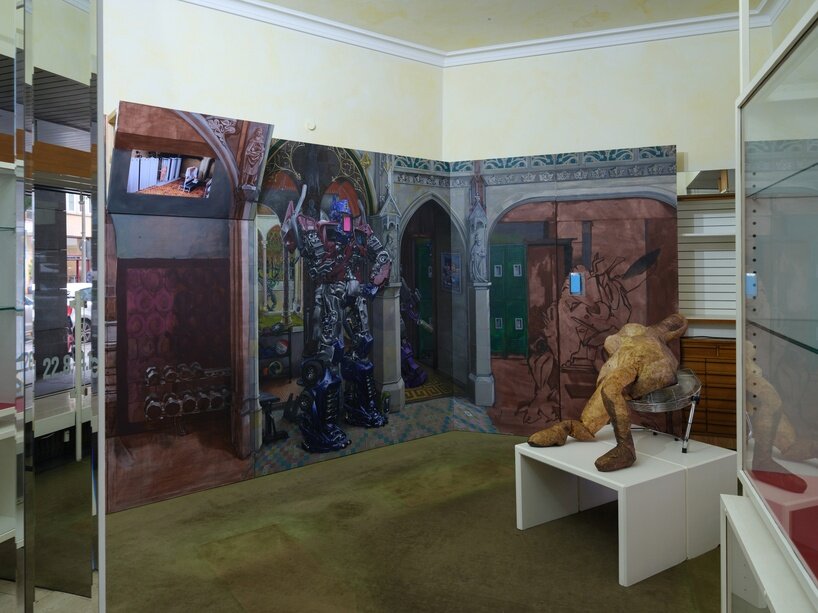
the inside of this ‘gym’ was derived from a hodgepodge of temporally disparate paintings referenced by the artists
Inflatable Bodies vs. Chrome Transformers
Just as they greeted visitors into the space, more of the inflatable sculptures whip around the interior of the installation. The duo have referenced Henry Moore’s works as the core inspiration behind their vaguely human forms. Positioned above large, very visible fans, their bodies expand and contract, filling their neutral-colored forms. They themselves are ‘working out,’ not so dissimilar to how one’s muscles would tense and relax or how their spine would curl while doing reps at a gym. With these creatures, so flaccid and flexible in front of the rigid, shining Transformers, they call into question the idea of the body. What does it mean to occupy a humanoid form? And what are the responsibilities that one has to take care of it, track it, and conceive of something that’s always in flux?
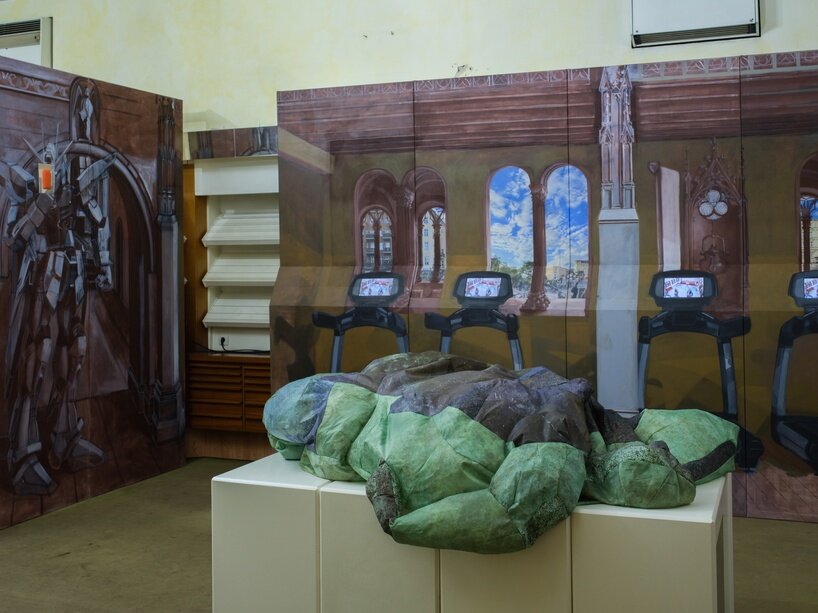
just as they greeted visitors into the space, more of the inflatable sculptures whip around the interior of the installation
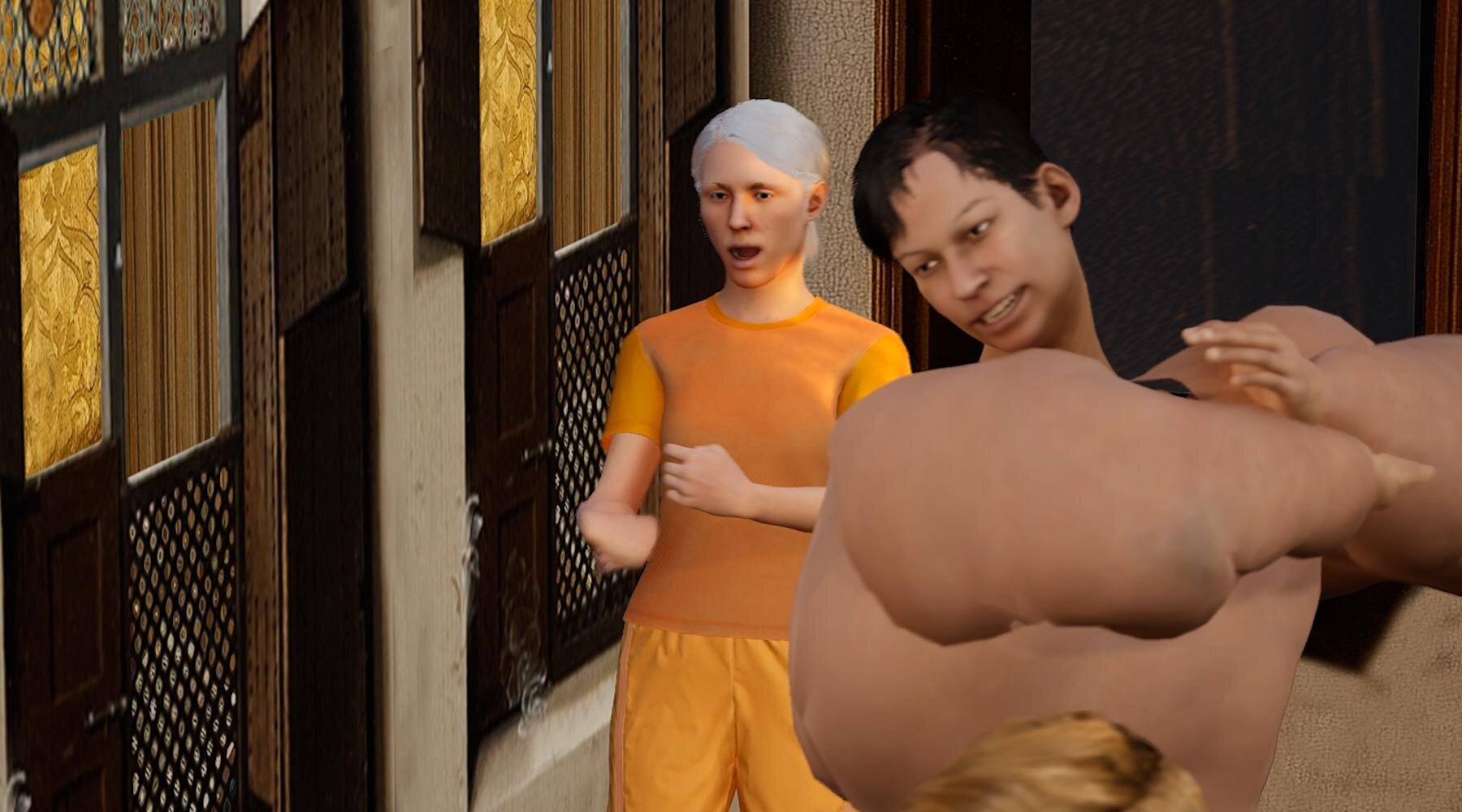
still from Method, 3D animated film, 2026 | image © Ellinor Aurora Aasgaard & Zayne Armstrong
Charli & The Factory, the film
The work that unites all the figures and forms of Aasgaard and Armstrong’s gym-turned-factory is the 30-minute animated film that follows Charli as she bumbles her way through the mystery surrounding a gory FitWatch malfunction, her character complete with purple hair and bright orange 5th Element-style suspenders. As she journalistically investigates what happens, she unearths the closed-lip, hypocritical nature of the makers, users, and promoters of this explosive invention.
As Charli interviews the gym manager, the maker, and her sexy hook-up/trainer who witnessed the event, she attempts to piece together why and how the FitWatch is causing bodily harm to people. In creating her exposé, which eventually gets cut up into a puff piece, she discovers that this smart technology, made to push people to perfection, is perhaps not helping the human race, but hurting it. Ultimately, the installation leaves the viewer feeling fraught—if even the means by which we improve ourselves are turned against us, let’s say for capital, vanity, or other contemporary malaise, what remains as a path toward betterment? If one were to even exist.
trailer for Charli & The Factory (2024) written by Ellinor Aurora Aasgaard, Zayne Armstrong
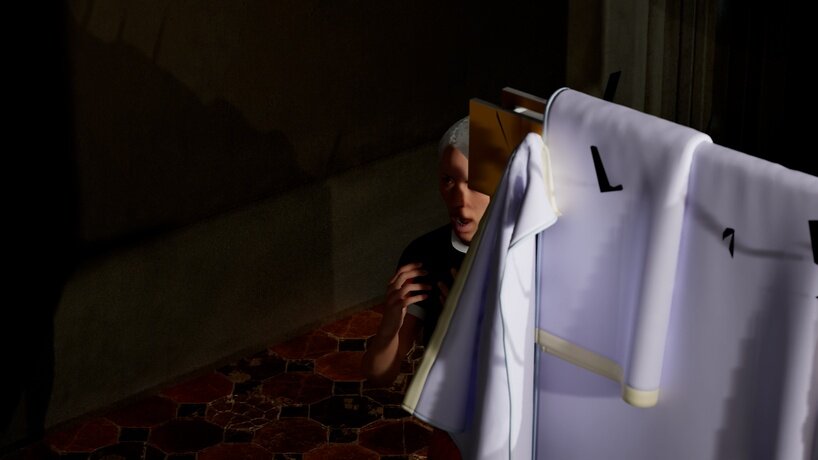
still from Method, 3D animated film, 2026 | image © Ellinor Aurora Aasgaard & Zayne Armstrong
Within the Uncanny Shifts program
Aasgaard and Armstrong’s installation is just one in the Uncanny Shifts program. In conversation with designboom, artistic director Britta Peters discusses how the duo fit snugly into the curatorial vision of the event with their strange techno-not-so-futuristic view of the now. After seeing previous iterations of the work, her and co-curator Alisha Raissa Danscher, invited them to create an expanded site-specific work for the program. ‘The focus on self-optimization and egocentric body culture fits perfectly with Uncanny Shifts because it brings in the themes of Neoliberalism and withdrawal of solidarity: People are turning into machines, like in the film serial Transformers. The film Charli & The Factory is a scathingly satirical work commenting on the social and economic dynamics of our times.’ The exhibition subtly snakes through the city, occupying timetables at the station, a pedestrian zone, and a church. Talking about how the artists’ faux gym occupies the former optician’s space, Peters hints at its uncanny timeliness, ‘there is already a big gym on the other side of the street.’
project info:
name: Charli & The Factory
artists: Ellinor Aurora Aasgaard and Zayne Armstrong | @maybeellinor & @zaynearmstrong
work dates: 2022-2024
location: Former optician‘s shop, Hansastraße 26-28, 44137, Dortmund
exhibition: Uncanny Shifts | @urbanekuensteruhr
curators: Britta Peters and Alisha Raissa Danscher
exhibition dates: August 22 to October 4, 2026
This article is part of designboom’s SPECTATOR AND SPECTACLE chapter, asking how wonder gets built, presented in partnership with SolidNature, and how it might return some mystery to a world that has measured most of it away. Discover more stories that turn onlookers into participants, alter perception and disrupt the everyday here.
The post optician’s shop turned art installation satirizes bio-tracking tech at uncanny shifts appeared first on designboom | architecture & design magazine.