




superstudio’s 12 ideal cities question the price of a perfectly designed life


Superstudio designed 12 impossible ways of living
In 1971, Superstudio imagined twelve cities designed to solve the problems of human existence and came up with solutions so complete that there was barely any life left to live. A person wakes up in a five-cubit cell. The temperature is permanently set at 25°C. The humidity never changes. Food and every other necessity arrive automatically. There is no work to do, no reason to leave, and no one else to meet.
The room knows what its inhabitant wants before they have to ask. It also knows when they are unhappy. This is the 2,000-Ton City, one of twelve imaginary settlements described by Gian Piero Frassinelli and Superstudio in Twelve Cautionary Tales for Christmas: Premonitions of the Mystical Rebirth of Urbanism, published in 1971. Better known as 12 Ideal Cities, the project is populated by disembodied brains, people who live through machines, citizens governed by books, and inhabitants carried through life by cities that operate like enormous industrial organisms.
They are strange, often funny, and increasingly cruel. More importantly, they are all built around the same trap: every city has found a solution.
In Superstudio’s cities there is no universal housing model, no master plan intended to work everywhere. Every story begins with a principle and follows it to its most extreme conclusion. What if every human need could be satisfied automatically? What if the body were no longer necessary? What if a city could organize its inhabitants according to perfect order? What if life could be made more efficient by treating the city as a machine? The questions may be simple, but the answers grow increasingly uncomfortable. This is what keeps Twelve Ideal Cities interesting. Superstudio takes familiar problems, gives them perfect solutions, then follows those solutions until they become something else entirely. In these cities, the system designed to make life easier gradually takes over life itself.
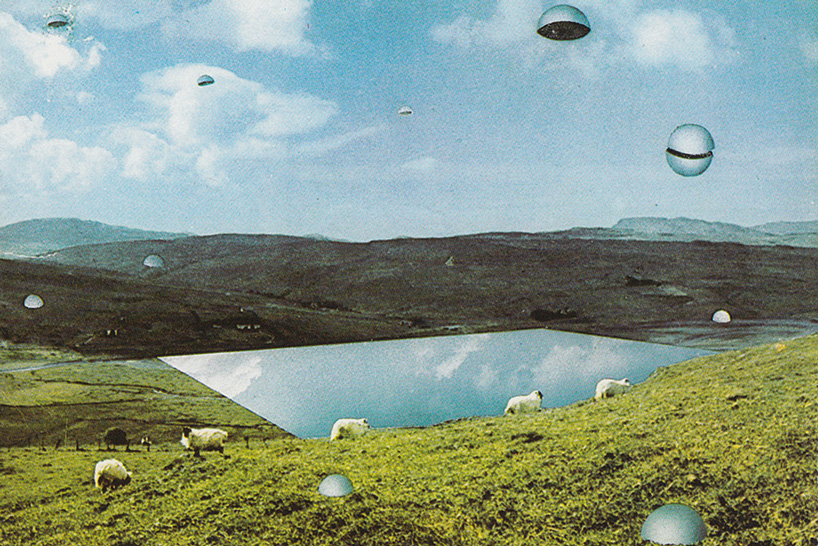
Twelve Ideal Cities – Twelve Cautionary Tales, 1971 | image via MAXXI
the city that gives you everything
The inhabitants of the 2,000-Ton City live alone, enclosed within individual cells. The city regulates the environment and responds to desire through an elaborate technological apparatus. A brain-impulse receiver communicates the wishes of the inhabitants to a central electronic system which organizes the response of the city.
Nothing needs to be searched for, made, or negotiated. It is difficult to imagine a more complete promise of convenience. Superstudio then introduces the detail that gives the city its name. If the system detects a citizen entertaining rebellious thoughts against their ‘perfect eternal life,’ a ceiling panel weighing two thousand tons drops. The problem has been removed and so has the person. It is an absurd image, but the joke is doing serious work. The 2,000-Ton City questions whether a life made entirely convenient is necessarily a life made freer. Its inhabitant has been relieved of almost every difficulty and, along with it, almost every opportunity to act. There is no need for other people because the system takes care of everything. There is no need to make decisions because the system anticipates them. The perfect home becomes a perfectly managed cell.
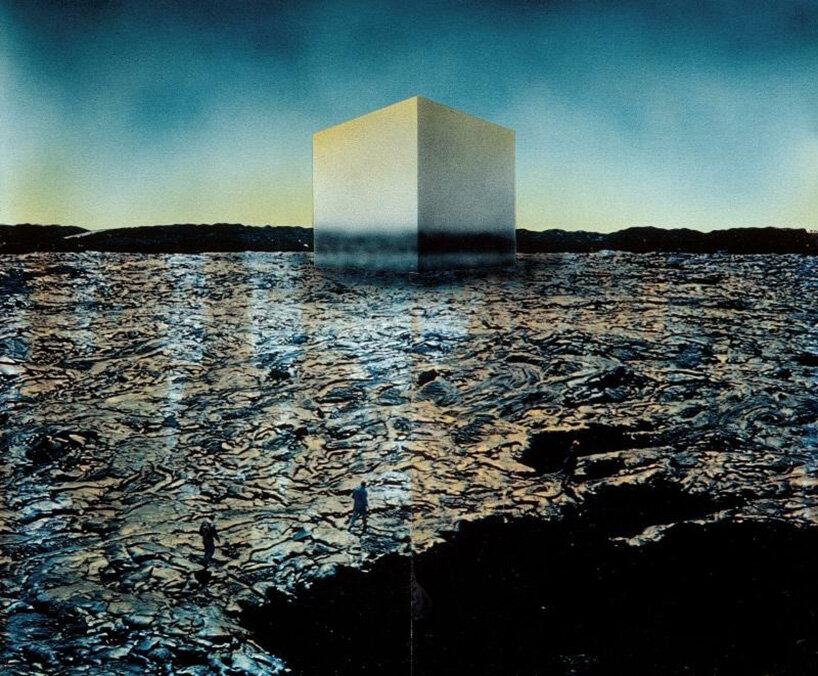
Superstudio, Terza città: New York of Brains, 1971 | image via Centre Pompidou, MNAM-CCI/Georges Meguerditchian/Dist. GrandPalaisRmn
no body, no house
The New York of Brains is exactly what its title suggests. Human brains are preserved in individual containers, sustained by technological systems and connected through electrodes. The traditional ingredients of habitation disappear with the body itself. No kitchens. No beds. No streets. No need to walk anywhere. In the City of the Hemispheres, bodies lie immobilized inside transparent containers while consciousness experiences the world through a separate apparatus.
In Spaceship City, inhabitants live through programmed experiences as the machinery around them controls the conditions of their existence. These stories make ordinary architecture suddenly seem very physical. A house is designed around bodies that need to sleep, eat, move, touch things, get sick, grow old, and share space with other bodies. Remove those conditions and the familiar architecture of daily life begins to disappear. Superstudio takes this idea to an almost grotesque conclusion. What is a home when there is no need to cook? What is privacy when the body itself has become a technical object? What is a city when its inhabitants no longer need streets? The answer is never presented as a technological triumph. The systems keep people alive, but Superstudio keeps asking, what kind of life is being preserved?

2,000-Ton City | image via Hidden Architecture
the city doesn’t need you. it needs you to work
Not every city isolates its inhabitants. Some absorb them. In the Temporal Cochlea-City, life happens inside an immense mechanical structure that continues according to its own physical logic. In other stories, cities become systems of continuous production, construction, and industrial activity. Here, the relationship between architecture and inhabitant begins to reverse. Usually, a city is understood as something built for people. Housing accommodates domestic life; streets allow people to move; infrastructure supplies what a population needs. Superstudio imagines a city that has its own rhythm. People must keep up. The inhabitant becomes a component within a much larger mechanism. It is a useful shift because it moves Twelve Ideal Cities away from the familiar image of radical architecture as a collection of spectacular drawings. The project is interested in what forms do to people. A spiral, a conveyor belt, or an enclosed machine is never just an image. Each produces a particular way of spending time, moving through space, relating to others, and reaching the end of a life. Architecture becomes a schedule, a social system, a biological system.
The strangest form of architecture in Twelve Ideal Cities may not look like architecture at all. In the City of the Book, the rules of life are carried by the inhabitants. The book contains the instructions by which existence is organized: norms, behaviors, and prescribed ways of acting.
The City of Order explores a similar idea. Control does not necessarily arrive in the form of walls, guards, or visibly oppressive buildings. It can appear as normality. Streets, houses, and everyday routines continue, while the system makes sure that deviation is corrected. Superstudio’s point is that control can be embedded in things that appear helpful, rational, or ordinary. A system can make life easier while deciding what kind of life it is designed to support. A housing plan can encourage one form of domesticity over another. An infrastructure network can determine who meets and who remains separated. A building can make certain activities effortless and others almost impossible. The City of the Book turns this invisible process into a literal instruction manual.

The Fourth City, Spaceship City- 1971 | image courtesy of Superstudio
the problem with an ideal city
It would be easy to call all twelve cities dystopias and leave it there. The project is more unsettling than a collection of bad futures. Each city begins with something recognizable: comfort, order, longevity, efficiency, pleasure, security or the elimination of unnecessary labor.
These are desires that remain among the reasons people build, design, plan, and invent. Superstudio’s trick is to ask what happens when one of them becomes the only thing that matters. A city devoted entirely to comfort eventually removes the need to do anything uncomfortable. A city devoted entirely to order has little use for disagreement. A system designed to eliminate uncertainty will eventually treat unpredictability as a malfunction. Superstudio takes each idea to its logical extreme. The cities offer clear answers to familiar questions about how we might live, but the further those answers are pushed, the stranger the resulting forms of habitation become.

Dodicesima città: città del libro (Twelfth City: City of Book), from Le dodici città ideali (Twelve Ideal Cities) | image via SFMOMA
leave some things unresolved
What makes Twelve Ideal Cities difficult to leave behind is that the absurdity is never really the point. Frassinelli takes ideas that already exist around him — the efficient city, the productive city, the perfectly controlled environment, the city organized around a single purpose — and refuses to stop at the point where they still sound reasonable. He keeps going until the consequences become impossible to ignore.
That method still works. We now live among many of the systems that were once easier to recognize as science fiction: automated environments, permanent connectivity, predictive technologies, and cities increasingly measured through data and performance. But the twelve cities are relevant because they ask a more basic question about what we are willing to give up in exchange for a life that is faster, easier, more efficient or more controlled.
The answer is different in each city, but the pattern is the same. Something is gained, and something else disappears. In one, the body becomes irrelevant; in another, production takes over the city; elsewhere, order becomes the organizing principle of everyday life, and the architecture follows. Eventually there is nowhere left for anything that does not belong. Frassinelli asks what happens when an idea about how we should live becomes the environment around us. Today, the question is still relevant: as technology becomes more involved in everyday life, how much of our lives do we want to let it shape?

Twelve Cautionary Tales for Christmas by Superstudio
This article is part of designboom’s MODES OF HABITATION chapter, exploring how the spaces we inhabit can reshape the ways we live together. Discover more stories rethinking domesticity, shared living, and the many forms a home can take here.
The post superstudio’s 12 ideal cities question the price of a perfectly designed life appeared first on designboom | architecture & design magazine.