

take your pleasure seriously: play as a way of being


When the idea for a chapter on play first came to me, I had no rigid framework in mind, and no major industry moment to tie it to. It was an intuitive decision, born perhaps from a need to seek out some light while the news gives us so little of it, or from a quieter reflection on what designboom has always been about. Not to look away from the weight of the world, but to remember what makes it worth carrying.
This pull toward joy and playfulness brought to mind a favorite Eames expression: ‘Take your pleasure seriously.’ The line sounds like a paradox, since pleasure, after all, is what we allow ourselves once the serious work is finished, if we allow it at all. For the Eameses, though, it was a working method. Play was a form of rigor rather than a break from it, and the joy that ran through their films, their toys, and their chairs was never incidental to the work, but rather how the work itself got made.
But somewhere along the way, most of us lost the knack for it. Seriousness hardened into restraint; a good life became something to optimize, streamline, and save. Joy turned into a reward for productivity rather than a reason to make anything at all. And yet, I feel designboom has always leaned the other way. For the past twenty-seven years, we have followed our curiosity and imagination out loud, experimenting and trying things simply because they seemed like fun, without ever taking ourselves too seriously. And we have tended to save our warmest attention for the people bold enough to do the same.

illustration by Philippos Avramides © designboom
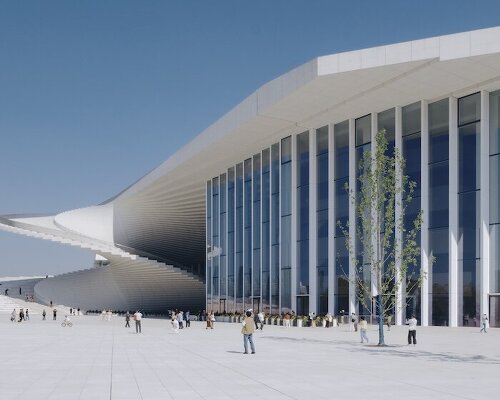
Boldness like that has always run against the grain of design’s own rulebook. ‘Form follows function,’ Louis Sullivan wrote, and modernism turned the phrase into something close to scripture: a discipline of efficiency, honesty, and use, with little patience for the ornamental or the absurd. This chapter proposes a small heresy: what if form didn’t follow function, but pleasure? What if a building, a space, or an object earned its place in the world not by how efficiently it performed, but by how much life it invited in?
To be clear, the play we are interested in is not frivolity, and it is certainly not the frictionless, gamified distraction the attention economy sells back to us. It is closer to what the child knows instinctively and the adult has to relearn: an open, unscripted, faintly rebellious way of being in the world, one that treats spending time as more valuable than saving it. It is the spirit Isamu Noguchi chased for the better part of his life, imagining playgrounds not as equipment to be used but as landscapes to be read, open enough for a child to invent the game, and radical enough that his own city kept turning them down. And it is what Constant Nieuwenhuys pushed to its limit in New Babylon, his decades-long model of a city where machines handle the labor and people are left free to wander, build, and drift, set loose to become what he called Homo Ludens: humans at play. Neither one was designing amusements so much as drawing a freer way to live.

Isamu Noguchi, models for ‘Playground Equipment,’ 1941, image via @noguchimuseum
Long before we built anything, we played. It is arguably our first creative act: the child who turns a cardboard box into a spaceship, a stick into a sword, a patch of floor into an ocean, is doing what every artist and architect does after them, using imagination to make one thing stand in for another, and a whole world out of almost nothing. Play is where we first rehearse the idea that reality is negotiable.
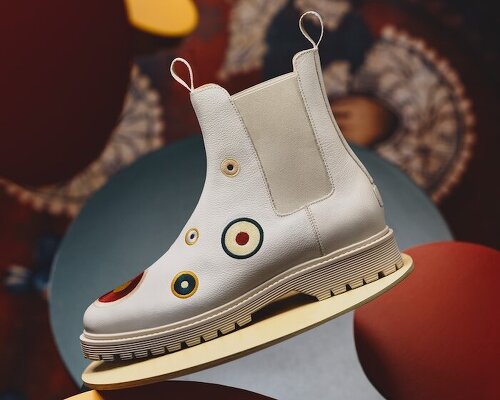
What follows in this chapter is less a manifesto than a collection of proofs. We visit playgrounds doing the quiet work of holding a neighborhood together, handle objects made to awaken the child in us regardless of age, and loiter, unapologetically, in spaces designed for spending an afternoon rather than saving one. And we ask what happens when the disruption of our daily routines, through something as small and spontaneous as play, begins to rebuild a more empathetic, human world: small, deliberate arguments that a life measured in time saved is not the only kind worth designing for. None of this is escapism. To choose joy when the world feels heavy is not to ignore its weight, but to insist that imagination is still one of the most powerful forces we have for shaping our realities. So consider this an invitation to take your pleasure seriously, and to join us in doing so.
This article is part of designboom’s Play chapter, exploring what happens when creators prioritize emotional warmth, vibrant geometries, and tactical leisure. Discover more related stories here.
The post take your pleasure seriously: play as a way of being appeared first on designboom | architecture & design magazine.