


wendell castle’s family home returns through furniture and artifacts at friedman benda

before the pedestal
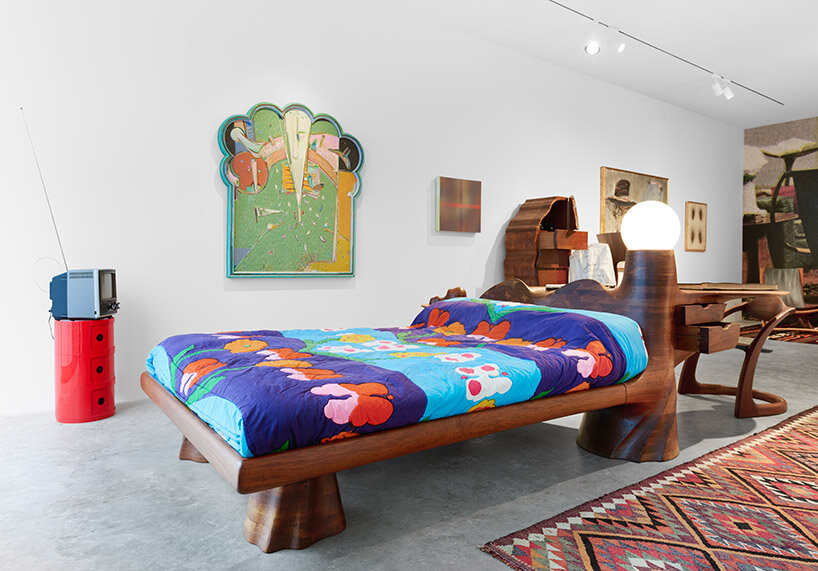
designboom attended the opening reception for Wendell Castle: Living at Friedman Benda, where the gallery had taken on the density of a lived-in home. A Kermit the Frog toy sits on Environment (1972), Castle’s colossal stacked-walnut bed and work station, and family home videos play on a small television alongside it. Books lie beside furniture and personal objects turn up between works that now belong to the history of American design. The exhibition‘s scale can be monumental, but the rooms feel inhabited.
Curated by Castle’s daughter, Alison Castle, the exhibition begins with a June 1973 House Beautiful feature on the family’s Scottsville, New York, home. The magazine caught Wendell Castle and ceramic artist Nancy Jurs living among their own work while much of it was still fresh from the studio.
‘Today, these works are usually seen in museums, but as furniture, they were made to be used,‘ Alison says. Her aim is to let visitors feel how the pieces functioned within the home.
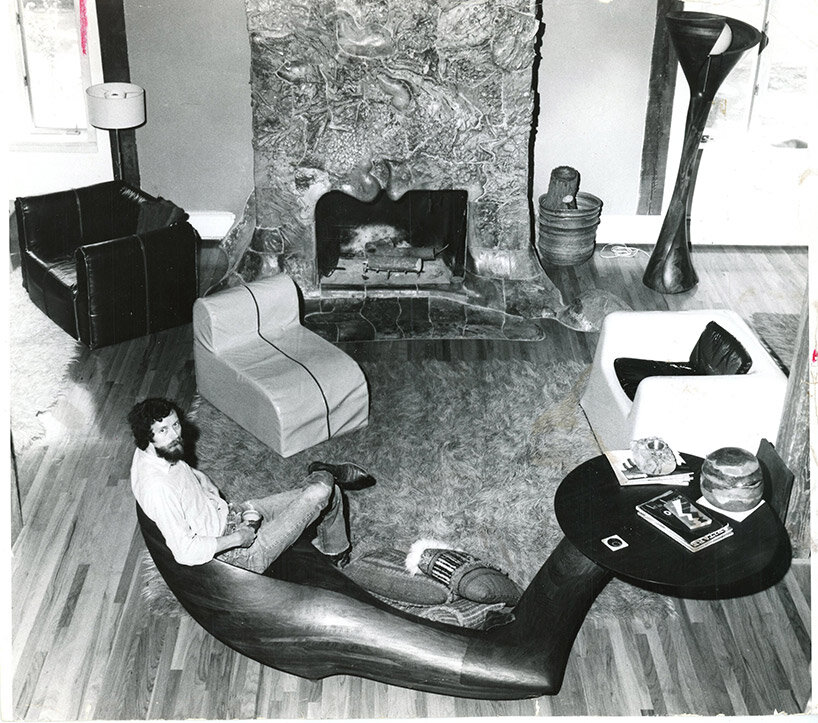
Castle Home, circa 1970s | image courtesy Estate of Wendell Castle and Friedman Benda
the house becomes an archive
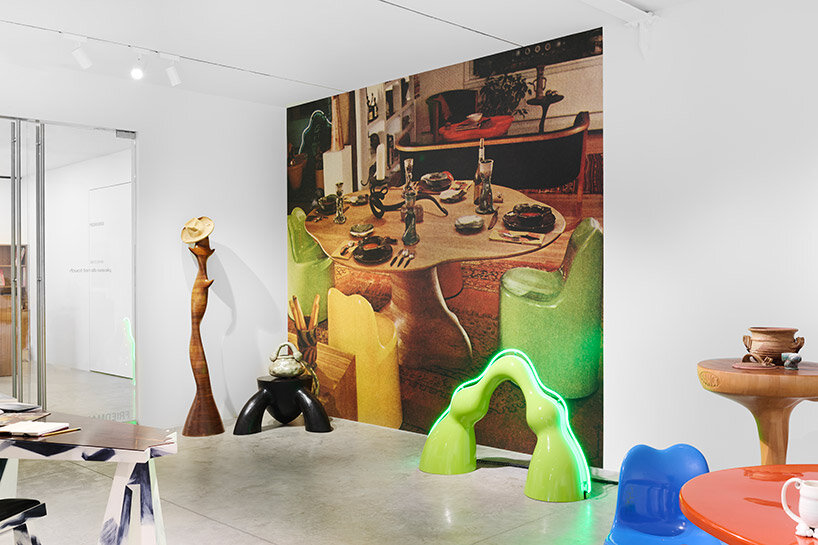
Across Friedman Benda‘s gallery space, enlarged photographs from the House Beautiful spread act like murals. Objects pictured in the designer‘s old rooms appear again in front of their own images, bringing the Scottsville interior into the present without turning it into a period reconstruction. The house occupied a former mill that Wendell Castle renovated, and its contents kept changing as work moved upstairs from the studio.
Alison has explained that pieces often entered the living space while waiting for a buyer, sometimes remaining with the family for years. Living with them gave her parents time to study what they had made and think through future work.
The house also recorded the creative world around Castle and Jurs. Their friends’ work entered through purchases and trades, including paintings by Michael Venezia and a ceramic fireplace by Roy Cartwright. Glenn Adamson’s catalogue essay also points to craft artists Tommy Simpson and Ann Sutton as part of the couple’s wider circle.
Alison remembers the atmosphere: ‘Our home became a total environment where furniture, ceramics, color and architecture blur together.‘ Castle appeared in both the wood and plastic sections of Objects: USA, the landmark 1969 Smithsonian exhibition that brought American studio craft to a much larger audience.
Wendell Castle: Living | image courtesy Friedman Benda and Wendell Castle Inc., photography by Izzy Leung
a career written into the grain
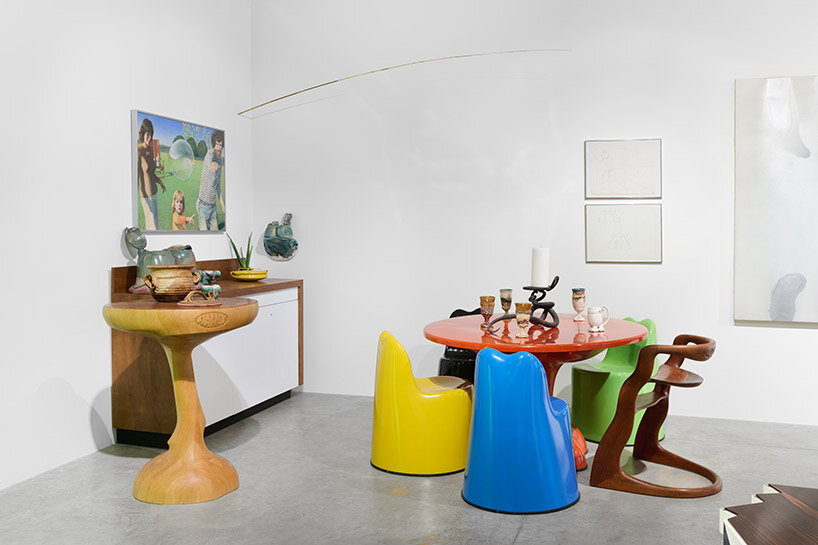
The installation also makes Castle’s technical evolution unusually easy to follow. His 1962 Chaise Rocker still lets the eye read oak members meeting through visible joinery, while another early chaise nearby carries the same sense of furniture assembled from distinct pieces.
In 1963, Castle began developing stack lamination, building timber into thick layered masses and carving them back into continuous forms. By Environment in 1972, stacked and laminated walnut had become architecture at the scale of furniture, with a bed and work surface absorbed into a broad horizontal wooden landscape. A lamp and drawers emerge from the same body.
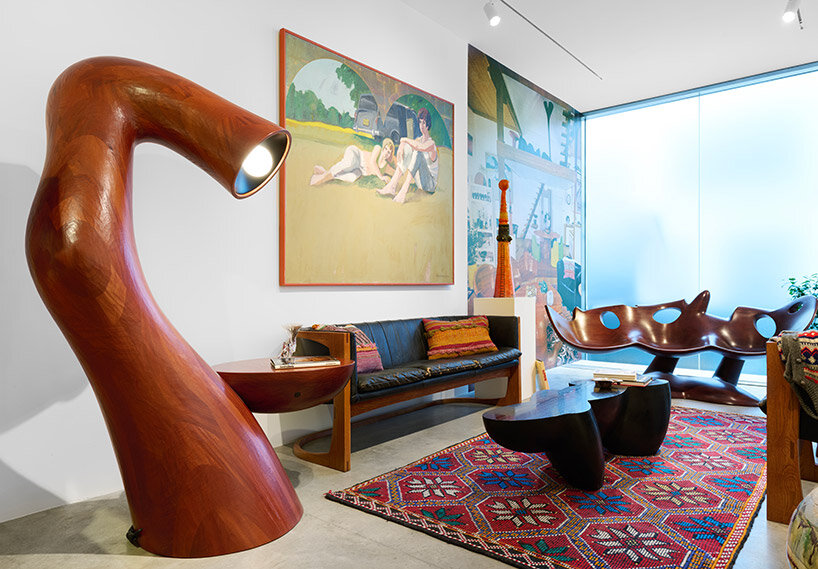
Across the room, Opposites Attract (2017) turns that logic on its side. The massive floor lamp rises from diagonally oriented laminated wood, with a side table and drawer integrated into its body. The grain sweeps upward through the form, making the construction itself part of the visual movement.
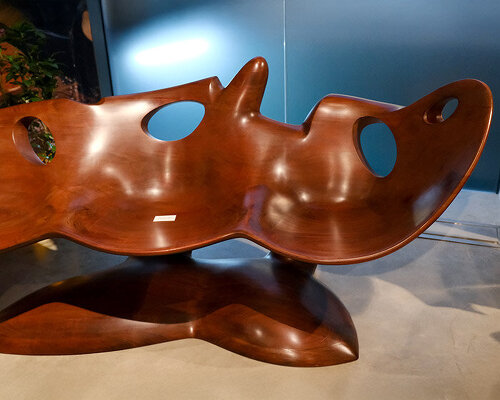
Nearby, Arcadia (2010) turns a three-seat bench into one continuous carved body, its openings and raised ends giving the mahogany form an almost anatomical rhythm. Seen together, the works let the eye track decades of experimentation through the direction of the wood.
Wendell Castle: Living | image courtesy Friedman Benda and Wendell Castle Inc., photography by Izzy Leung
family furniture keeps its traces
Some of the most affecting objects are also among the smallest. Castle made a wooden high chair for Alison, carving her name across the back in broad graphic lettering. Elsewhere, a 1973 coat rack carries his own hat, still covered with wood shavings from his final time working in the studio. These details place biography directly onto the furniture. The high chair belongs to childhood; the hat still seems to belong to the workshop.
Nancy Jurs’ presence runs throughout the rooms with equal ease. Her ceramics sit on tables and shelves, echoing the vessels visible throughout the 1973 magazine spread, while friends’ artworks keep the installation open to a wider creative circle.
Jurs would later move further into sculptural ceramics, including her Wall Pouches of the 1980s, but here her vessels retain their place within the household. In the old photographs, Castle’s bright molded seating shares rugs and tabletops with handmade ceramics. Friedman Benda brings that visual density back into the room.
Wendell Castle: Living | image courtesy Friedman Benda and Wendell Castle Inc., photography by Izzy Leung
kermit on a masterpiece
The Kermit toy on Environment may be the detail that explains the whole exhibition best. The piece is huge and technically ambitious, yet here it becomes a bed again. Family videos flicker nearby. Alison’s curatorial premise comes through in these small collisions between canon and use, where a major work can hold a childhood toy and a gallery can briefly take on the looseness of a family room.
By the time Wendell Castle: Living reaches Castle’s later works, the exhibition has become both a chronology and a portrait of the world around the objects. You can follow changes in woodworking through the seams, then look up and find Jurs’ ceramics or a friend’s painting nearby. Before these works entered museum collections and design histories, people sat in them and slept beside them. At Friedman Benda, that earlier life comes back into view.
Wendell Castle: Living | image courtesy Friedman Benda and Wendell Castle Inc., photography by Izzy Leung
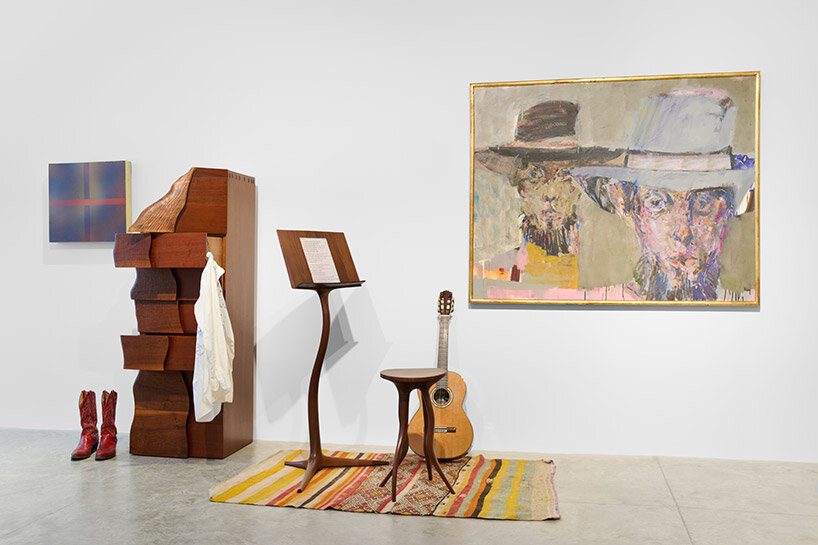
Wendell Castle: Living | image courtesy Friedman Benda and Wendell Castle Inc., photography by Izzy Leung
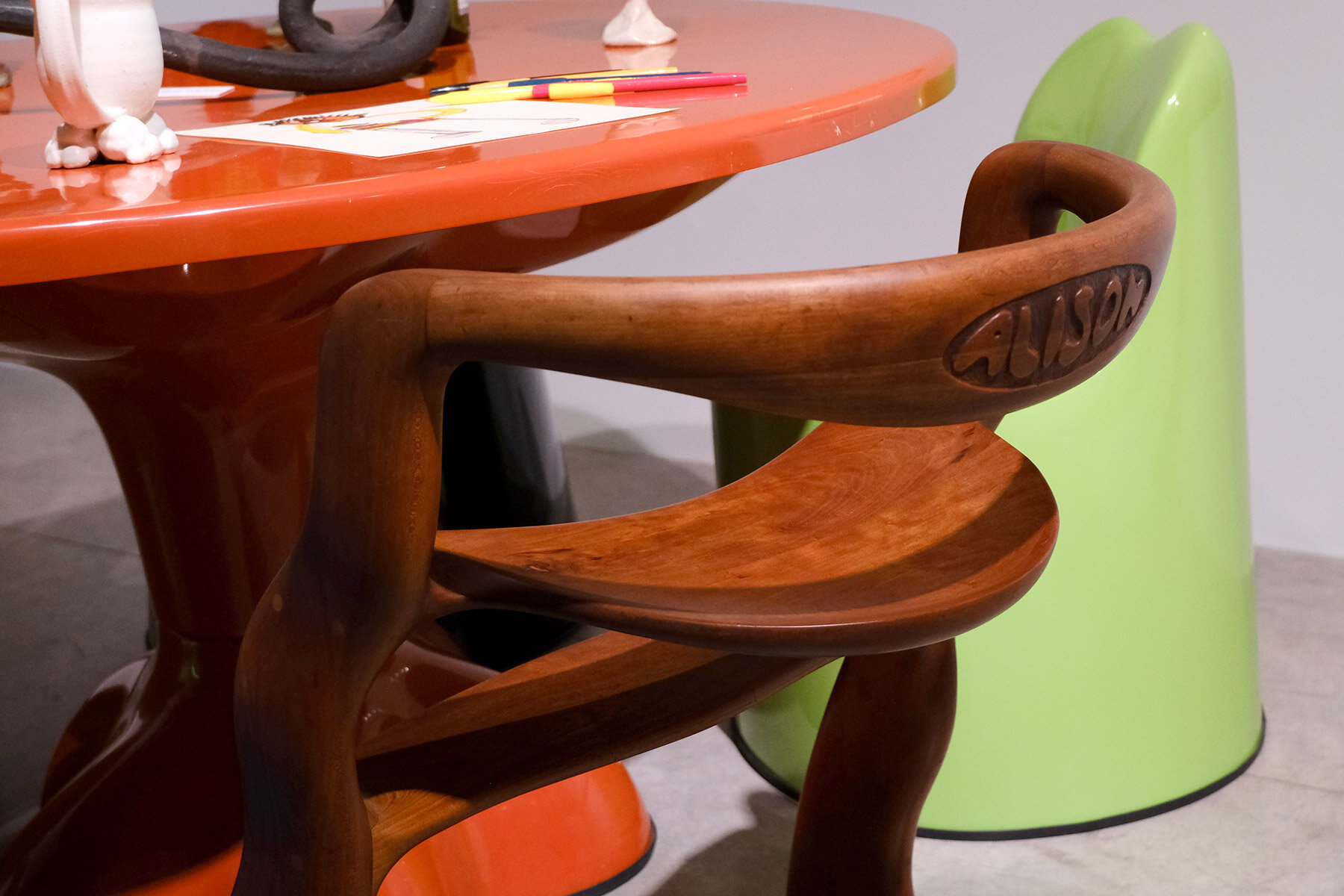
Wendell Castle: Living | image © designboom
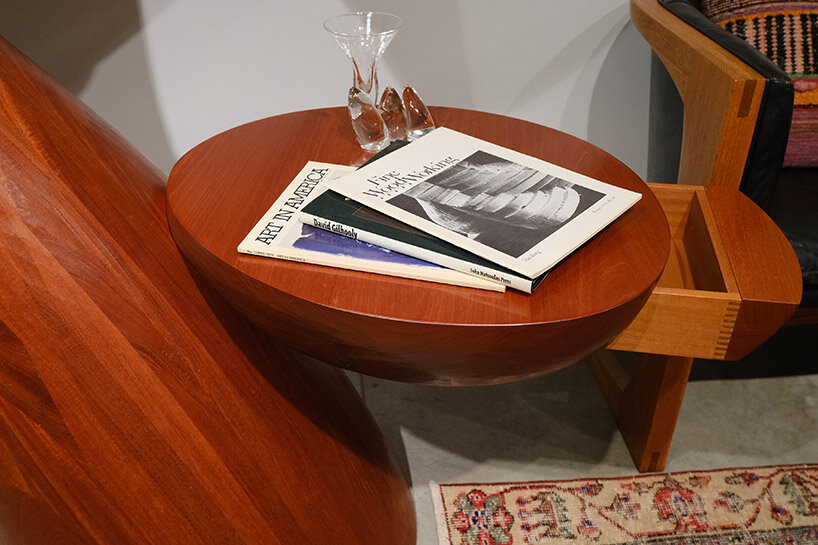
Wendell Castle: Living | image © designboom
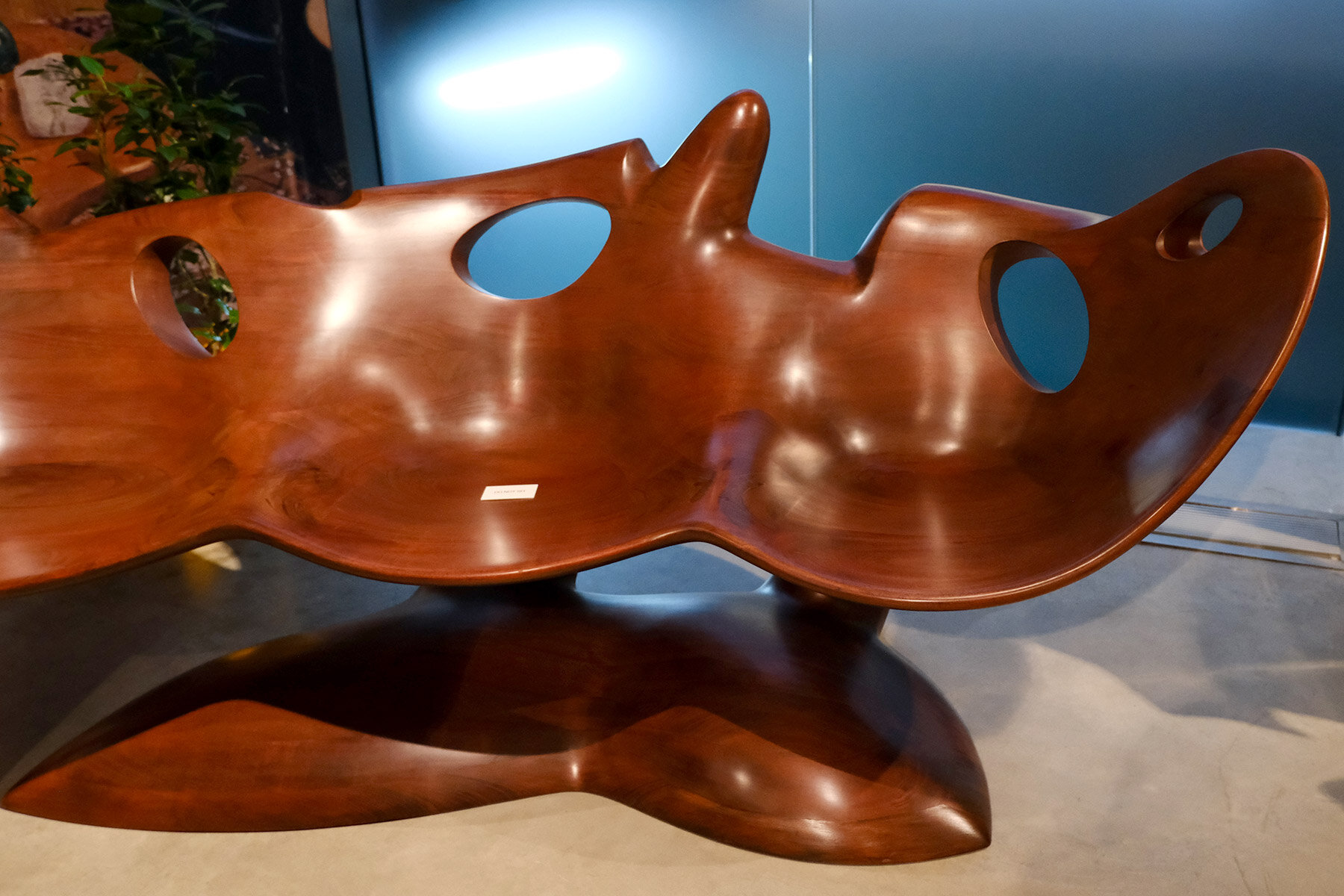
Wendell Castle: Living | image © designboom
project info:
name: Wendell Castle: Living
designer: Wendell Castle | @wendellcastle_official
gallery: Friedman Benda | @friedman_benda
location: 515 West 26th Street, New York, NY
dates: September 17th — October 17th, 2026
photography: © designboom, © Izzy Leung, courtesy Friedman Benda
The post wendell castle’s family home returns through furniture and artifacts at friedman benda appeared first on designboom | architecture & design magazine.