




why entering the japanese design market requires more than exporting nordic aesthetics


TRANSLATING DESIGN VALUES ACROSS BORDERS WITH ELNA NYKÄNEN ANDERSSON
When design travels abroad, objects stop being simple products and start acting as quiet signals of a nation’s values. For the fifth feature of Navigators of Design, a 10-part interview series produced with Most Studios, designboom connects with Elna Nykänen Andersson, Counsellor for Public Diplomacy and Communications at the Embassy of Finland in Tokyo. Drawing from her background in journalism and international media for various big outlets, Nykänen Andersson brings a nuanced perspective to the intersection of design, brand identity, and international relations. In her current role, design is far more than commercial exports — it act as active cultural tools to express Finnish society, lifestyle, and core values on a global stage.
‘Success can mean so many things. But in terms of standing out from the crowd and, in some ways, representing a country, I think it comes down to offering something unique, standing the test of time and being honest,’ opens Elna Nykänen Andersson the interview. ‘It’s increasingly important to work with brands that believe in and live by the same values that Finland does. Sustainability, democracy, equality, innovation, open-mindedness, and quality, to name a few. For us, design and architecture are fantastic tools for illustrating the Finnish mentality, lifestyle, values, and way of doing things.’

banner: Iittala exhibition at Finland’s embassy in Tokyo
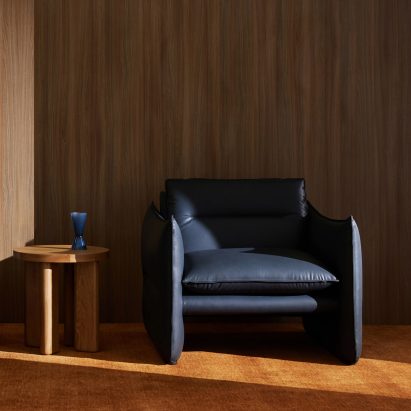
above: Perhonen table lamp from the Yrjö Kukkapuro Collection by Modeo at the Scandinavian Design Embassy event at the Embassy of Finland in Tokyo in 2025
HUMAN-CENTERED CRAFT BRIDGES FINNISH AND JAPANESE TRADITIONS
Working from the Embassy of Finland in Tokyo, Nykänen Andersson explores the innate cultural resonance between Finnish and Japanese design mindsets. Despite vastly different geographic origins, both traditions prioritize natural materials, human scale, and an intuitive elevation of everyday life over grandiose statements. Iconic Finnish entities like Artek, Iittala, and Marimekko have carved a lasting presence in Japan by aligning with a local culture that deeply values longevity, tactile experience, and time-honored craftsmanship.
‘It’s a lot about elevating everyday life and creating design that feels human,’ notes Nykänen Andersson. ‘The Nordic tradition is often more democratic and industrial: well-designed objects that can be manufactured at scale, made available to many people, and used in ordinary homes. The Japanese craft tradition is perhaps more intimate and ritual-oriented, perfecting the shape, material, and tactile experience of an object used in a repeated daily act. The end result may look simple, but achieving that simplicity often requires an enormous amount of knowledge and skill.’

the Scandinavian Design Embassy initiative promotes Scandinavian brands through events at Nordic embassies around the world
BUILDING TRUST AND CULTURAL CODES
For studios seeking to expand internationally, navigating complex markets like Japan requires moving past the assumption that local domestic appeal seamlessly translates abroad. Sustainable international growth depends on physical presence, deep listening, and finding local partners who share a common vision.
‘In general, when trying to enter a new market, brands sometimes seem to think that the same thing that works at home will also work elsewhere. But just because something is considered a strength in your country doesn’t mean it will be distinctive in another,’ explains Nykänen Andersson. ‘After a year in Japan, I’ve noticed that translation here is about much more than words. It’s also about behavior, relationships, presentation, timing, and cultural codes. One exhibition, launch, or visit is rarely enough to create a meaningful, long-term presence in Tokyo. It takes returning, following up, and gradually building trust’.

Installation view of Marimekko: Art of Printmaking ー Beauty, Dream, Love at The Museum of Kyoto | image © Shuhei Sakai
Presenting design to an international audience offers a rare lens into broader societal narratives. When sharing iconic Finnish works abroad, Nykänen Andersson uses object histories to unpack foundational national stories. A timely example is the UNESCO World Heritage Committee’s recent decision to inscribe 13 architectural sites — collectively known as Aalto Works — onto the World Heritage List. Rather than celebrating Alvar Aalto in isolation, UNESCO explicitly framed these works as collaborative creations alongside Aino Marsio-Aalto, Elissa Aalto, and the studio team, reframing design history around teamwork and gender equality.
‘Instead of focusing on Alvar Aalto alone, UNESCO describes them as having been designed by him in collaboration with Aino Marsio-Aalto, Elissa Aalto, the employees of the Aalto studio and Artek,’ shares the Counsellor. ‘Aino was an architect and designer as well as a co-founder of Artek. Elissa played an essential role in the Aalto office and continued its work after Alvar’s death.’

Studio Aalto, Helsinki UNESCO World Heritage Alvar Aalto Aalto Works Finlandia Hall | image © Tuomas Uusheimo
The philosophy of slow, meaningful exchange finds contemporary expression in cross-cultural collaborations like the recent partnership between Artek and Tokyo footwear label Hender Scheme. Combining Artek’s classic birch with Hender Scheme’s vegetable-tanned leather, the collection offers a playful, tactile intervention on timeless forms.
‘The collaboration grew through several years of conversations and visits between Tokyo and Helsinki,’ concludes Nykänen Andersson. ‘Both sides bring something very recognizable of their own, resulting in something fun, new, and refreshing. I especially love the pair of leather “shoes” that fit onto the legs of Alvar Aalto’s classic Stool 60. A small and playful intervention that makes you see a familiar object in a new way.’

Artek + Hender Scheme Stool 60, including Hender Scheme Stoll Shoes, color natural | image © Artek and Hender Scheme

portrait of Elna Nykänen Andersson | image © Marica Rosengård
project info:
Navigators of Design Series: a collaboration with Most Studios
Design has never changed faster. These are the people navigating that change.
Navigators of Design is a 10-part interview series produced in collaboration between designboom and Most Studios. As the landscape of brand and design evolves at an unprecedented pace, we sit down with the senior leaders — CEOs, Creative Directors, and Heads of Design — shaping the world’s most influential companies.
From rethinking workflows to defining design as a core business differentiator, these conversations provide a platform for the visionaries lifting the industry to new heights.
The post why entering the japanese design market requires more than exporting nordic aesthetics appeared first on designboom | architecture & design magazine.