















ayumi tsuchiya’s wooden sculptures are made for touching, playing, and listening


Ayumi Tsuchiya’s wooden sculptures encourage curiosity
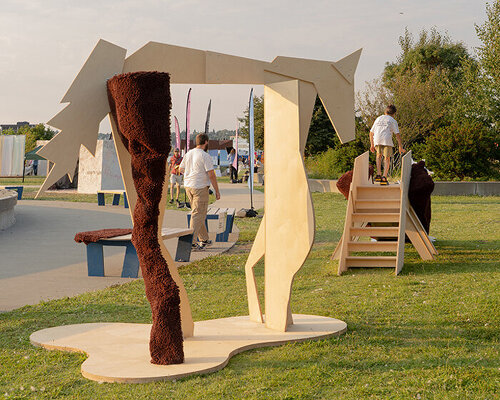
Children rarely stop to ask how Ayumi Tsuchiya’s sculptures work but intuitively climb inside them, rock back and forth, push, pull, and listen. Adults, on the other hand, look for instructions first. That difference has become one of the defining observations behind the Japanese artist’s practice. Across hand-built wooden chairs, musical seesaws, oversized carved bowls, and flower-like seats, Tsuchiya’s practice revolves around objects that ask for the body as much as the eye. Her works occupy a space between sculpture, furniture, instrument, and playground, asking to be used before they are understood. ‘Children begin to play instinctively,’ she tells designboom. ‘When adults see my work, they initially try to ask how to use it, but children first touch it and understand how to interact with it and how it works through experience.’
A rocking chair becomes a bench when turned upside down. A flower-shaped chair gently folds around the person sitting inside it. A seesaw becomes a xylophone as riders move together, while a monumental wooden bowl, hollowed out by hand, invites visitors to climb in and sway as if they had suddenly shrunk into the world of Japanese folklore. ‘Children are geniuses. That’s not to say adults aren’t—it’s just that because they understand the rules of society and try to live by common sense, they seek an explanation first. Through my work, I hope that adults, in particular, will reconnect with the sensibility that lies dormant within them,’ the artist shares.

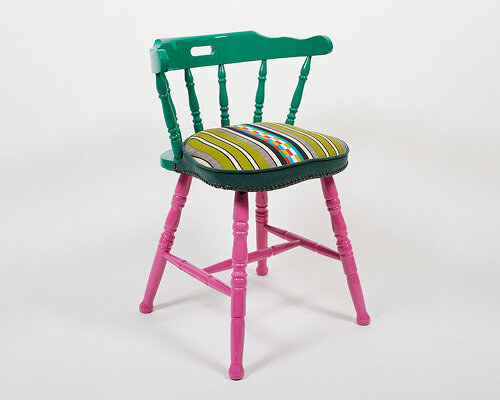
Thumbelina’s Chair | all images courtesy of Ayumi Tsuchiya
Creating spaces for people to connect
Ayumi Tsuchiya didn’t arrive at this way of working through a fascination with contemporary art. Quite the opposite. ‘I love creating things,’ she tells us. ‘But to be honest, I wasn’t really interested in art to begin with. I didn’t find much enjoyment in simply going to an art museum and just looking at the works.’ She became more and more interested in what could happen around an artwork and not so much in front of it.‘That’s why I wanted to create interactive artworks, and more than that, I wanted to create the space itself where people can communicate through these works,’ the artist adds.
Music runs through many of Ayumi Tsuchiya’s projects, though not for the reason one might expect. ‘The reason I incorporate music is that I can’t play any instruments,’ she admits. ‘I love to sing, but I was terrible at it. That’s why I have such a strong longing for music.’ The artist began building instruments that almost anyone could play. In works like Do-Re-Mi-Fa-Si-So, melodies emerge through movement, while Doremi-fa Sofa turns shifting body weight into a simple musical composition as wooden balls travel across a xylophone.

Circle Song
Handcrafted woodworking and kinetic design
Every piece starts as a sketch before moving through technical drawings, timber selection, joinery, and fabrication, all carried out by the artist herself. ‘I have things I want to create,’ Ayumi Tsuchiya shares with designboom. ‘But more than that, I have a deep desire to keep using my hands to make things.’
‘I sketch, draw blueprints, select the wood, and do all the processing myself. I love visualizing the piece, choosing the wood, figuring out how to build it, and actually making it with my own hands,’ the artist adds.
In an age where interactive art is increasingly driven by screens, sensors, and software, Tsuchiya continues to build experiences through gravity, balance, gears, timber, and touch. The mechanics remain visible, and so does the hand of the maker. ‘I think digitization is wonderful. I also like digital art,’ she says. ‘But aside from that, I’m an analog person at heart.’
These carefully crafted objects, chairs, bowls, and instruments are really invitations to move, to listen, to laugh, and perhaps to remember, if only for a moment, what it feels like to approach the world with the curiosity of a child.

Singing circle

Singing circle

Gear Wonderland No.12

Gear Wonderland No.10

Circle Song

Singing Internal Gear

Singing Internal Gear

Singing Gears

Sound

Gear Wonderland No.12

Gear Wonderland No.10

Gear Wonderland No.12

Gear Wonderland No.12

Gear Wonderland No.11

The Sound Path

The Sound Path

Sound Steps
project info:
artist: Ayumi Tsuchiya | @ayumi._.tsuchiya
This article is part of designboom’s PLAY chapter, exploring what would happen if form didn’t follow function, but pleasure. Discover more stories that celebrate joy, imagination and playfulness here.
The post ayumi tsuchiya’s wooden sculptures are made for touching, playing, and listening appeared first on designboom | architecture & design magazine.