




leisurama’s prefabricated promise of fabulous, mid-century vacationing for all


Leisurama Homes and postwar vacationing
It’s 1965 in Culloden Shores, Montauk, a small beach community at the eastern tip of Long Island, New York, and a crop of identical homes have sprouted up. They are a brand of vacation homes called Leisurama, complete with a befittingly midcentury logo of bouncing letters. They were prefabricated and a few grand and came with Melmac plates, Murphy beds, and the postwar promises of summer fun and middle-class vacationing. When the Montauk Historical Society exhibited original goods that came in the Leisurama Homes, they complemented the online tour with a quote from architect William Morgan: ‘the Leisurama story is rarely told without some tale of a woman going to Herald Square to buy a bra and coming home with a house instead.’

the leisurama homes, pictured in an artist rendering from the book Leisurama Now: The Beach House for Everyone 1964- | image courtesy of Paul Sahre
The bras and homes sold at Macy’s department store
A Leisurama home was bought much in the way one would buy any other. There were three options; the home would come fully furnished from Macy’s, and you could move in when it was ready. The homes were notably designed by architect Andrew Geller and superstar French-American designer Raymond Loewy. Throughout the ’30s and into the midcentury, Loewy was designing everything from Greyhound buses to luxurious department stores to toothpaste tubes, with his pervasive design prowess culminating in his feature on the cover of TIME magazine in 1949.
Mia Certic, Executive Director at the Montauk Historical Society, not only oversaw the institution’s 2024 exhibition on the historic local housing development, but her primary residence is an original Leisurama home she inherited from her family. Speaking to designboom, Certic recalls move-in day back in the ’60s, when the community around Leisurama first started. ‘We all moved in at the same time: the furniture was delivered street by street, so that everybody on, say, Butternut Drive, got their furniture on the same day. It made us neighbors immediately. And for those of us who were children, we had an instant gang.’

interior of a near faithfully preserved Leisurama home from the book Leisurama Now: The Beach House for Everyone 1964- | image courtesy of Paul Sahre
About 200 homes and a donation of Melmac dishes
Approximately a year prior to their exhibition, the Montauk Historical Society received a donation containing all the original furnishings of an original Leisurama. Certic had decided that it would be fitting to recreate, not the home itself, but something akin to the Macy’s showrooms that prospective buyers could peruse at the department store. Speaking of her own family’s buying experience, Certic’s own mother, a student of interior design, was impressed by Loewy’s name on the project. ‘So she dragged my father to Macy’s, where you could walk through an actual house,’ she recounts, ‘and at that stage they were marketing really aggressively because they hadn’t sold very many (people were afraid that it was too good to be true, and thought that Montauk was way too remote to be practical). The salesman offered my parents a free weekend at the Montauk Manor to go and see where the houses would be built, and they thought, why not, nothing to lose.’ Certic remembers her dad drawing up a pros and cons list. When the latter was nearly empty, they decided to go through with the purchase.

some of the objects that would come in a Leisurama homefrom the book Leisurama Now: The Beach House for Everyone 1964- | image courtesy of Paul Sahre
Easy Living in a Leisurama
Certic herself went from summers in her family’s Leisurama to living in the house full time. When thinking about the original home she spent summers in, she notes how, despite the minimal square footage, the compact design with a lot of storage allowed cousins, grandparents, and friends to comfortably pile in for the sunny months. She also notes, ‘No air conditioning, and terrible tv coverage, but we didn’t mind because we just hung out on the beach, on our bikes, at the pond, etc. I also think it’s a rather quaint, postwar American notion to develop summer housing for the average working family!’ She thinks back on the many successes of the house, ultimately remarking that, ‘the strongest thing that Leisurama got right was that, back in the 1960s, if you built and furnished a bunch of houses in a beach town and sold them for a very reasonable price, you would create an incredible community and lifelong friendships. And who knows? Maybe the same thing is true today.’
In 1991, Certic’s family, like most who held onto one of these homes, embarked on a remodel. Although they got rid of most of the original furniture and updated the materials and insulation, she’s proud to have the skeleton of the home intact. ‘Despite having plans drawn up by a good local architect, they [Certic’s parents] ended up feeling that the original design was just so good they didn’t want to mess with it too much… they kept the beautiful cathedral ceilings (although they bleached the dark beams) which provide a real feeling of space and light.’

ad copy in a magazine selling the Leisurama homes in the 60s | image courtesy of Montauk Historical Society
Leisurama Now: the homes nearly 50 years in the future
In the preface for his 2008 book, Leisurama Now: The Beach House for Everyone 1964-, graphic designer Paul Sahre describes looking for a cheap place to rent for the summer. He was with his friend and fellow graphic designer, Nicholas Blechman. Coming from New York City, the mythos, sun, and proximity of Montauk called to them. As a note, the town is also known for being a pivotal backdrop for the 2004 film Eternal Sunshine of the Spotless Mind and the site of Camp Hero, a Cold War-era laboratory that was rumored to have tested on kids with special powers à la Stranger Things.
Eventually, he had landed on a house that had been part of the Leisurama development, notably an ‘Expanded Convertible Leisurama’—there were three models you could choose from back in the ’60s. He notes a visual evolution laid out in front of them, which he describes as, ‘one could almost see the neighborhood morphing into something else in fast-for-ward. Since the buildings were originally identical, each alteration made over time (and sadly, each Leisurama that’s torn down), is made visible, even if the motivation behind each change is not.’

one of the homes in the early 2000s | image © Michael Northrup courtesy of Paul Sahre
Leisurama as a sign of the times
Upon his third summer in the neighborhood, Sahre asked his photographer friend Michael Northrup ‘to come out to the beach to invoke Ed Ruscha,’ referencing the artist’s keen eye for capturing the American landscape in projects like his durational, photographic shots of the entire Sunset Strip. Together, Northrup and Sahre captured, from a fixed exterior point of view, every Leisurama home in Culloden Shores. In addition to this visual time capsule, the book goes into detail about the development of the homes, the product detail of each of the furnishings, and the landscape in Montauk that frames the whole thing.
Reflecting on the decades that have passed since he created the book, Sahre, in conversation with designboom, wonders what other modifications have been made to those ‘basicallly identical,’ houses he was so enmeshed with all those years ago. He ends with, ‘Montauk has always been remote. That has contributed to the weird factor. Even with proto hipster invasion, ‘surf lodges’ and the sky rocketing real estate prices, Montauk will always be Montauk.’

cover of the book the book Leisurama Now: The Beach House for Everyone 1964- | image courtesy of Paul Sahre

paper ephemera from the homes in the book Leisurama Now: The Beach House for Everyone 1964- | image courtesy of Paul Sahre

one of the homes in the early 2000s | image © Michael Northrup courtesy of Paul Sahre

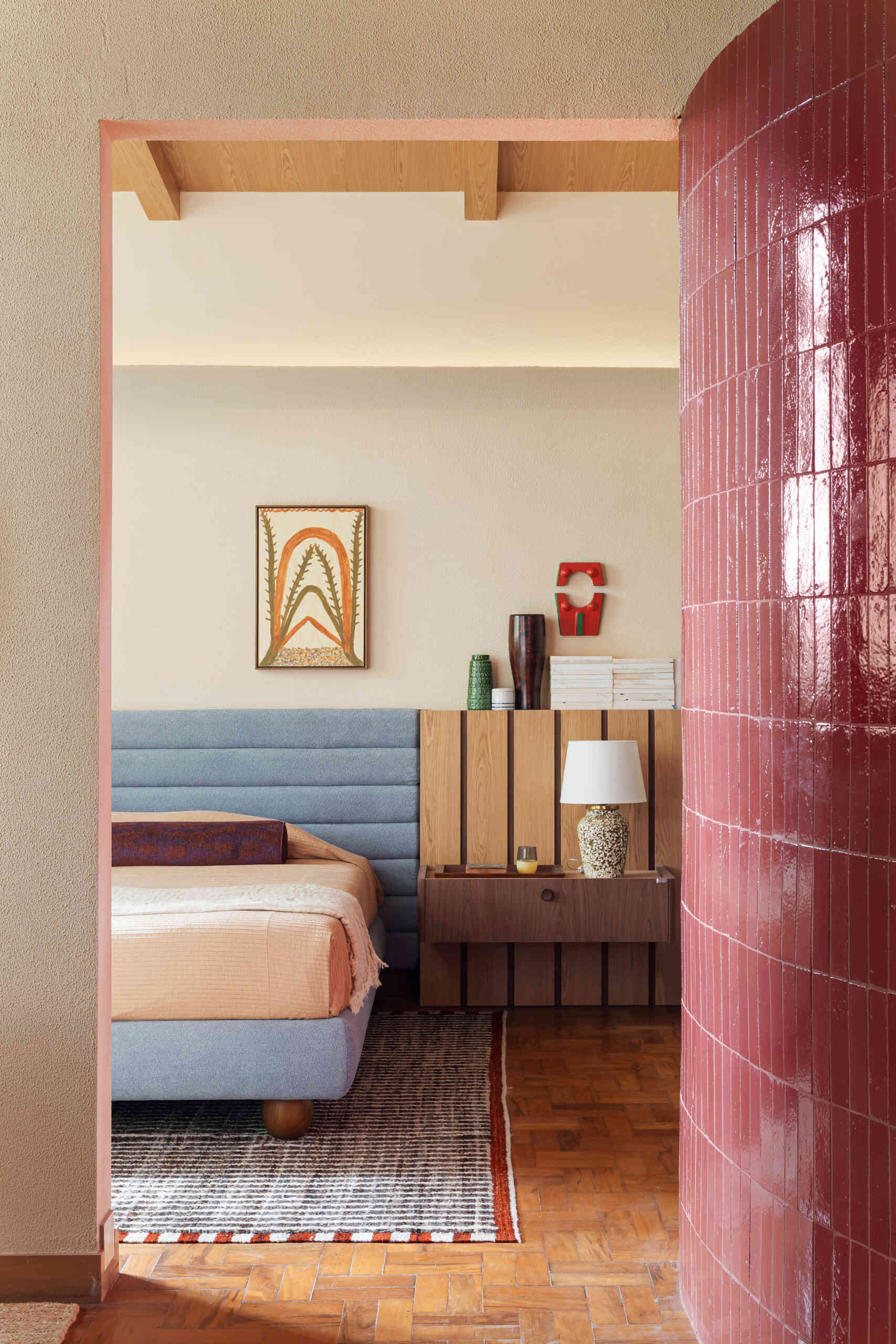
the contemporary interior of Mia Certic’s home, one of the original Leisuramas | image © Mia Certic
project info:
exhibition: LEISURAMA
exhibtion date: June 30, 2024 – September, 2024
location: Carl Fisher House, Montauk Historical Society, Long Island
executive director: Mia Certic
book: Leisurama Now: The Beach House for Everyone 1964-
publishing date: 2008
author: Paul Sahre | @psahre
studio: Office of Paul Sahre (O.O.P.S.)
The post leisurama’s prefabricated promise of fabulous, mid-century vacationing for all appeared first on designboom | architecture & design magazine.