






















US approves deployment of giant space mirror to illuminate Earth after dark


California startup Reflect Orbital has received permission from the US federal government to test a controversial satellite bearing a 18-metre-wide mirror, which the company claims could help to light up streets and fuel solar farms at night.
Following approval from the Federal Communications Commission (FCC) last week, the company plans to launch its Eärendil-1 demo satellite into low Earth orbit later this year.
Once there, it will unfurl a giant thin-film reflector that will act as a mirror to reflect sunlight back to the dark side of the Earth, illuminating a roughly three-mile-wide spot equivalent to the size of five Central Parks, according to Reflect Orbital.
The startup plans to sell this reflected sunlight to companies and municipalities at up to $5,000 an hour, allowing them to illuminate streets and neighbourhoods without electricity, and charge up solar farms after dark so they can generate more energy.
In its order granting the license, the FFC described the satellite as a "potentially groundbreaking technology" that "advances American leadership in space".
Critics warn of impact on "human health, agriculture and wildlife"
The federal approval flew in the face of opposition from scientists, who have warned that the light beams could "flash blind" aeroplane pilots, hinder astronomical research and interfere with circadian rhythms, which influence growth and germination in plants, regulate sleep and hormone release in humans and other animals.
The FCC received over 1,800 comments regarding Reflect Orbital's application – most of them negative.
"It is clear that the activities that Reflect Orbital is proposing will have an impact on the Earth environment, including on human health, agriculture and wildlife, in addition to astronomy," said Roohi Dalal, director of public policy at the American Astronomical Society.
But the commission maintained that environmental considerations fall outside its purview, centred on authorising satellites' use of the radiofrequency spectrum for navigation, and that space is ultimately not subject to the same environmental laws as Earth.
Reflect Orbital has not shared detailed design specifications for its test satellite, which would allow a comprehensive risk analysis.
The company's co-founder and CEO Ben Nowack said the trial launch will allow his team to collect data on the satellite and its 18-metre-wide (60 foot) mirror, and check the "safeguards" installed to control the light beams it creates.
"We're grateful to the FCC for recognizing the importance of testing novel technologies in space," he said.
Larger mirrors could reflect light of 100 full moons
If successful, Reflect Orbital hopes to launch another 1,000 satellite mirrors by the end of 2028, and a total of 50,000 by 2035. The largest of these would measure up to 55 metres (180 feet) wide and shine the equivalent of 100 full Moons back to Earth.
Even just one of these sunbeams would appear four times brighter than the full Moon for those within it, an analysis by the European Southern Observatory has concluded.
Reflect Orbital argues these concerns are offset by the potential benefits for people and planet.
"Imagine the endless possibilities when sunlight is not limited by geography or time of day," the company writes on its website. "A search-and-rescue team locates a missing person in minutes. A city has safer, evenly lit streets without the carbon emissions. Construction projects complete in half the time with teams able to work through the night safely."
But Reflect Orbital's claims of providing "clean, abundant energy" on demand fail to consider the rocket fuel burned to get satellites into orbit and the pollution they create, which together account for nearly half of the total climate impact of the space sector.
Other large-scale geoengineering projects proposed to fight climate change include a Space Bubble shield conceived by MIT researchers to reduce the effects of global warming.
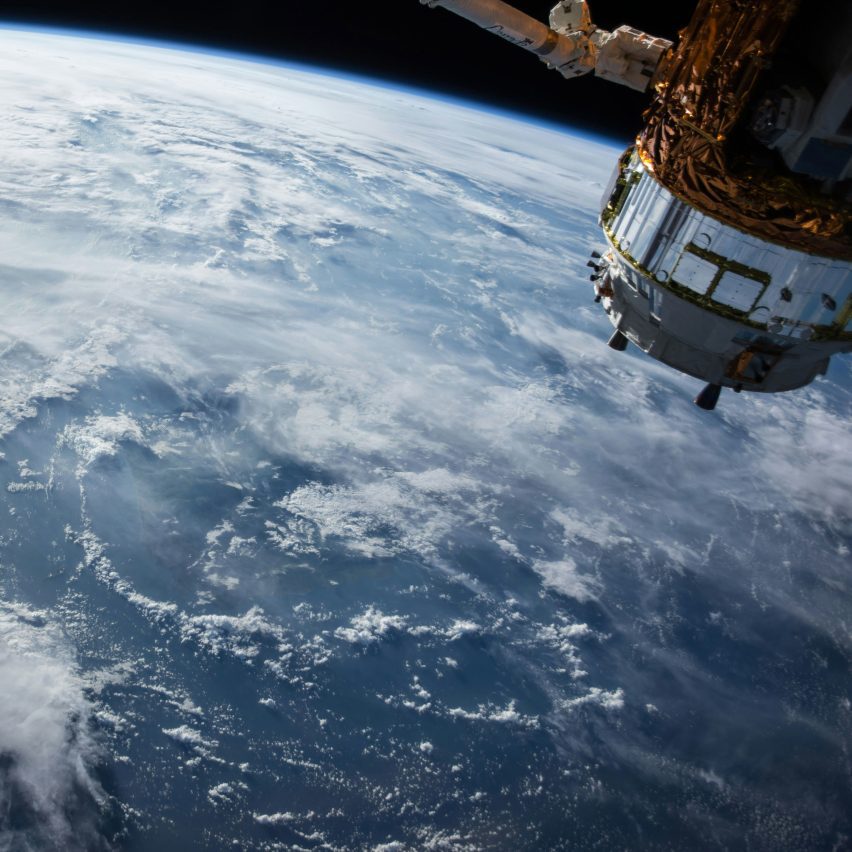
The top image of a satellite above Earth is by NASA.
The post US approves deployment of giant space mirror to illuminate Earth after dark appeared first on Dezeen.