

the court as canvas: how sports grounds became one of design’s favorite public spaces


the Sports Court Became a vibrant New kind of Playground
Sports courts are among the most standardized spaces in the city. Their dimensions are fixed, their markings universally recognized, and their purpose is clear long before anyone steps onto them. Whether in Paris, Accra, Shanghai, or Los Angeles, a basketball or tennis court speaks the same visual language, shaped by painted arcs, boundary lines, circles, and rectangles that have changed remarkably little over time.
Over the last decade, artists, architects, and designers have repeatedly returned to the sports court to explore what happens when one of the city’s most ordinary pieces of infrastructure becomes a site for experimentation. Some of their projects transform the painted ground into monumental graphic compositions, others rethink how courts are built and inhabited, while a growing number stretch the typology beyond sport altogether.
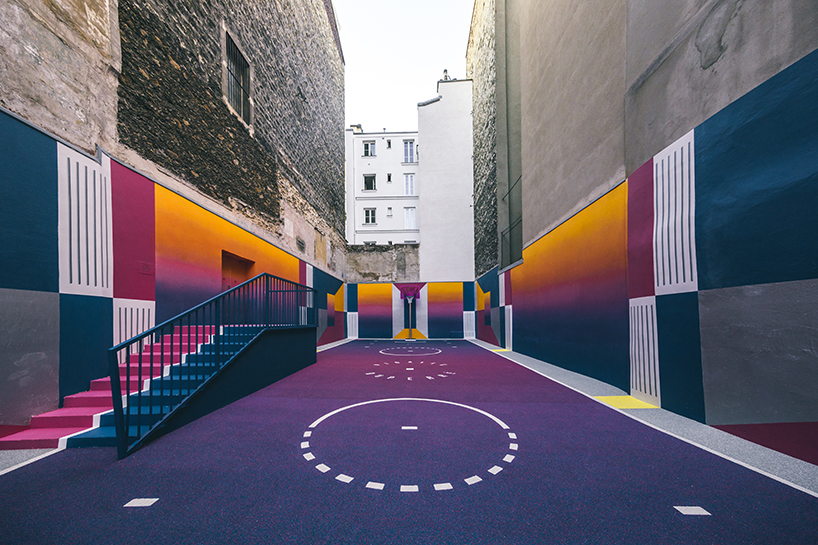
Pigalle basketball court by ILL-studio (read more here) | image by Alex Penfornis
it began with paint
Pigalle’s Duperré court, completed in collaboration with Ill-Studio, embraced the existing geometry of the court. Basketball markings dissolved into gradients of pink, blue, and violet that climbed surrounding walls, turning the entire site into a single graphic composition. Unlike a mural that is viewed from the street, the court demanded participation. Its composition shifted through movement as players crossed gradients, spectators gathered along its edges, and photographs taken from surrounding balconies transformed the space into one of the most recognizable public images of the decade. When Pigalle returned to renovate the court again in 2020, the intervention acknowledged a neighborhood basketball court that had become part of contemporary design culture.
Pigalle opened the door for a growing number of artists to think of the court as a graphic medium. Each approached it differently, expanding the experimentation beyond the bold gradients that first captured international attention. The movement has also been shaped by organizations working exclusively at the intersection of design and sport. Since 2014, Project Backboard has collaborated with artists across the US to transform neighborhood basketball courts into permanent works of public art, demonstrating that creative courts are part of a growing international wave.
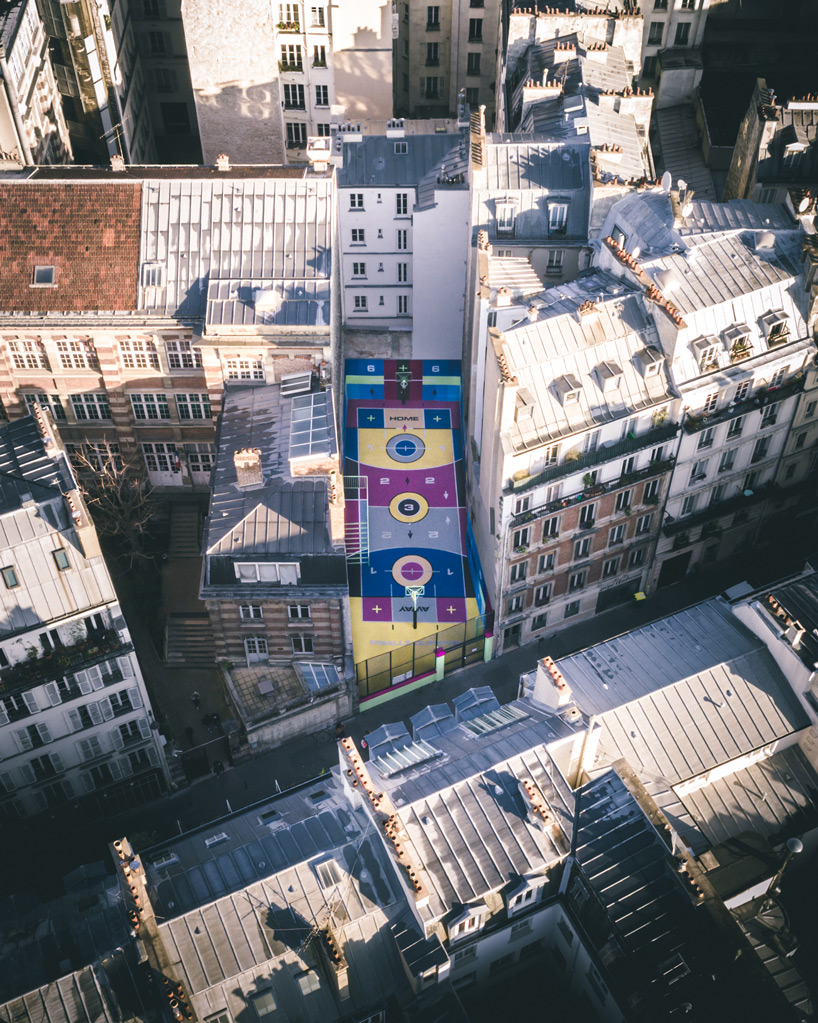
Pigalle basketball court by ILL-studio, 2020 renovation (read more here) | image by Alex Penfornis
In Arkansas, British artist Lakwena transformed a community basketball court into a vibrant field of color and affirming messages, inviting local communities to see the space as something shared and celebratory. Elsewhere, American artist Victor Solomon introduced an altogether different narrative. His Literally Balling court in South Los Angeles drew inspiration from the Japanese practice of kintsugi, where broken ceramics are repaired with gold lacquer. Golden lines fractured the playing surface like repaired cracks, suggesting that basketball courts, much like neighborhoods themselves, carry histories of damage, resilience, and renewal. A similar interest in play as a social catalyst runs through Yinka Ilori’s Creative Courts initiative, which combines bold color palettes with participatory design to encourage communities to reclaim neighborhood sports facilities as shared civic spaces.
Katrien Vanderlinden’s basketball court in Abu Dhabi borrowed the intricate geometry and ornamental richness of Middle Eastern carpets, replacing the visual language of street graphics with references rooted in regional craft traditions. In Belgium, Drukdoenerij approached the court almost as a piece of oversized graphic design, using bold typography, saturated colors, and abstract forms to transform an otherwise ordinary playing field into a landmark.
Although their aesthetics differ dramatically, these interventions work with the existing geometry of the court, allowing painted circles, arcs, and boundary lines to become active elements within larger compositions.
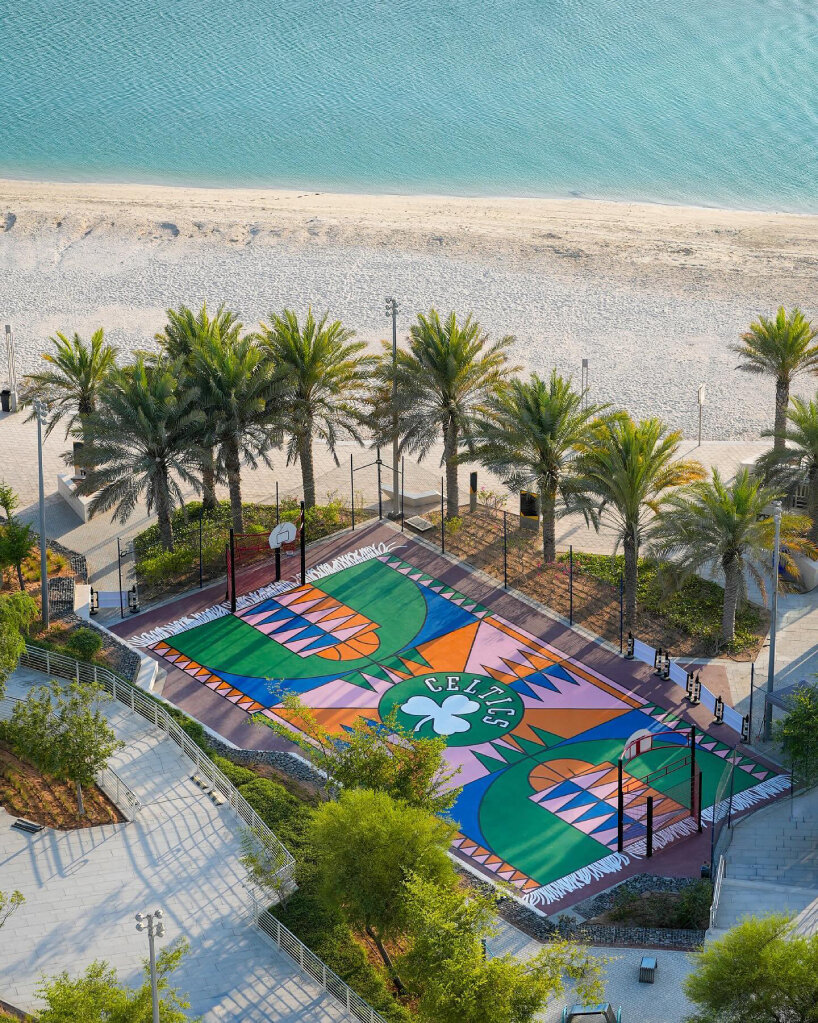
Celtics Rug by Katrien Vanderlinden (read more here) | image courtesy of Katrien Vanderlinden
then architects changed the court itself
As artists transformed the court into a graphic canvas, architects turned their attention to the space itself, its materials, landscape, and relationship to the communities it serves.
In Deroche Projects’ community tennis court in Ghana, sport becomes inseparable from architecture. Built using precast rammed-earth components, the project draws directly from local construction knowledge, positioning the court as a piece of everyday infrastructure that supports community life alongside tennis.
A similar expansion of the typology appears in SOBA’s sports park in Huachiao, China, where the architects design an entire landscape around movement. Basketball courts, running tracks, seating areas, and flowing canopies come together into one continuous public environment, encouraging visitors to wander between sport, leisure, and everyday social life.
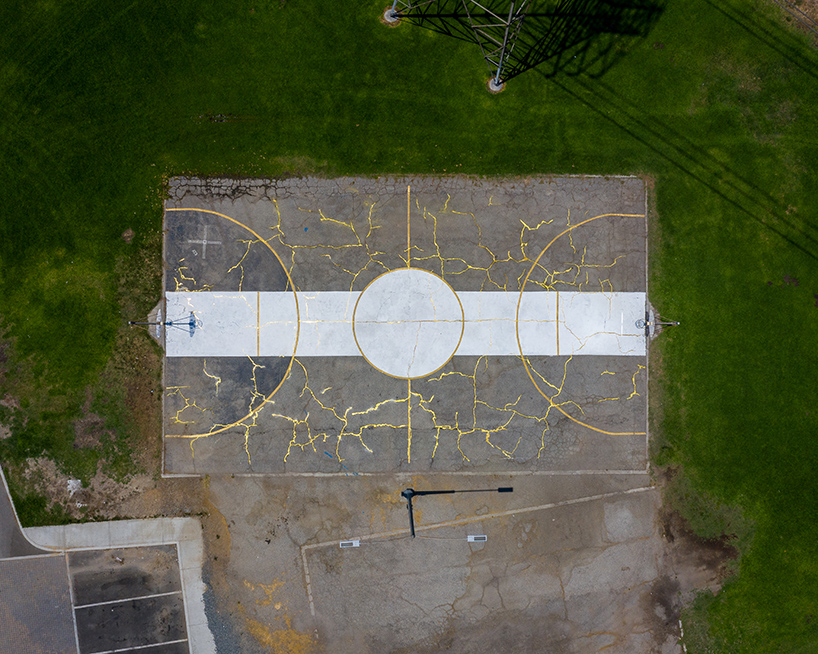
Kintsugi Court by Victor Solomon (read more here) | image by Shafik Kadi
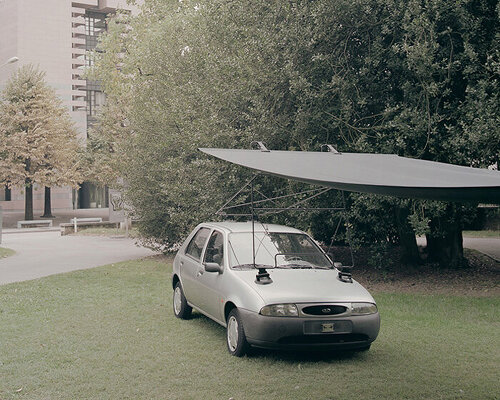
The conversation expands even further in 2050+’s Frontones Danzantes, presented during Concéntrico 2026 in Logroño. The Milan-based practice developed a series of movable frontones inspired by the traditions of Pelota Vasca, where architectural surfaces become active elements of the game. Installed within a parking lot, the structures temporarily transform a space dedicated to cars into one devoted to play. Their mobility allows the site to be continually reconfigured, suggesting that sports infrastructure can be lightweight, adaptable, and capable of reclaiming underused urban spaces instead of occupying new ones.
Unlike the painted courts that came before, these projects suggest that the sports court is a spatial framework capable of accommodating new ideas about construction, ecology, and public life.
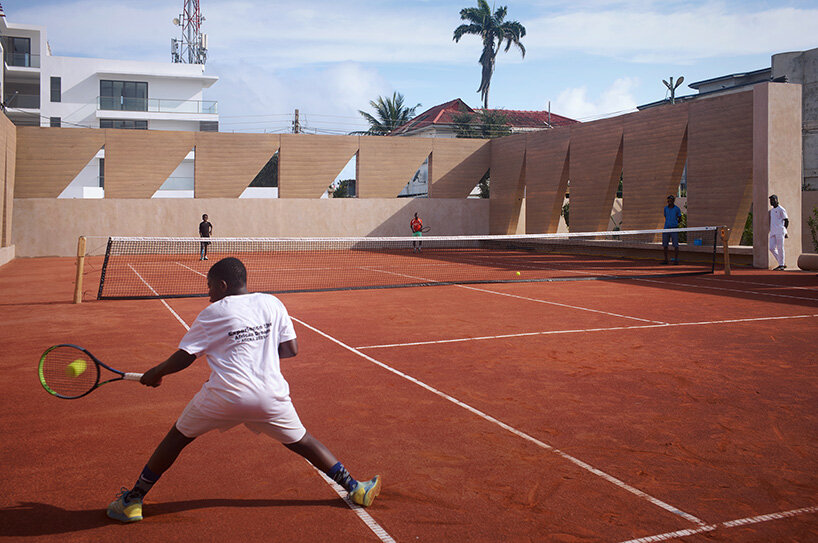
Backyard Community Club by DeRoche Projects (read more here) | image by Julien Lanoo
when the court became something else
Eventually, some projects borrowed the unmistakable geometry of the court to explore entirely different paths of participation, performance, and public space.
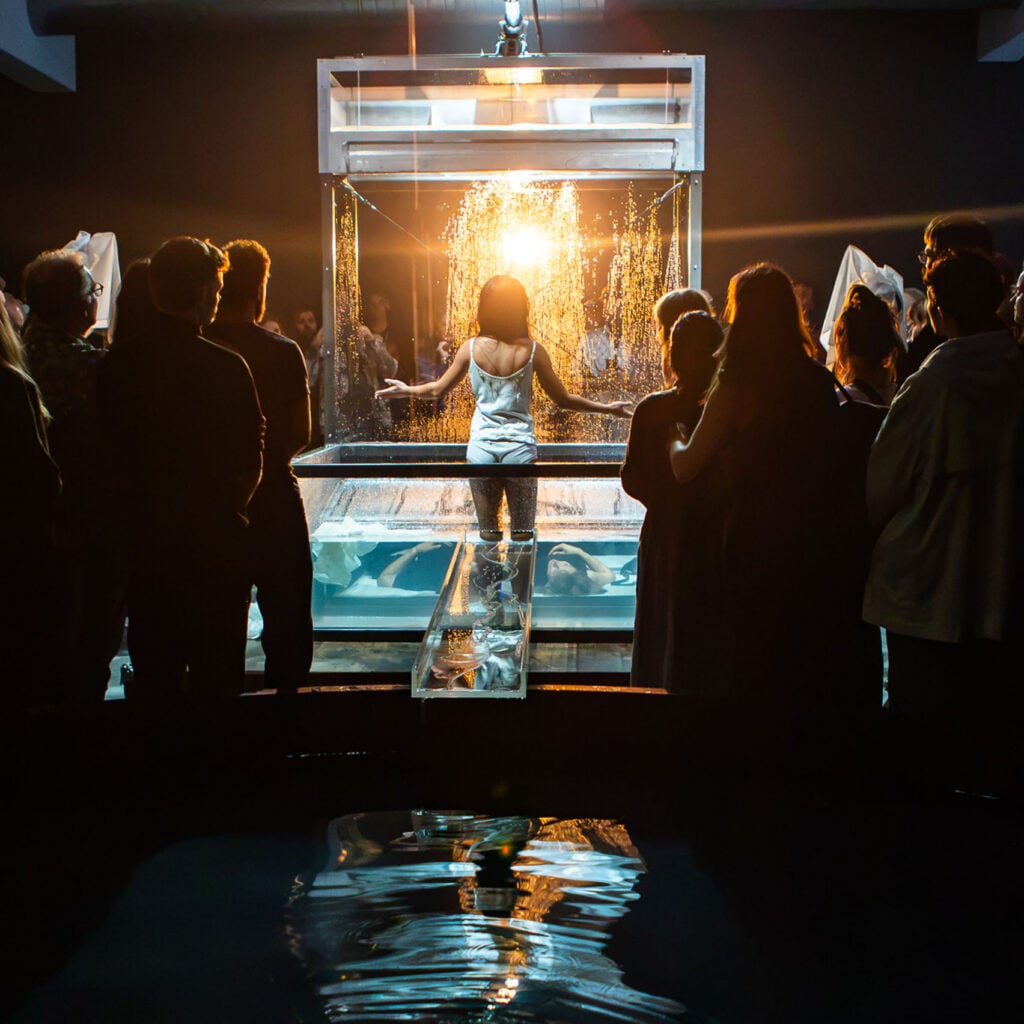
Asad Raza transformed Milan’s deconsecrated Church of San Paolo Converso into a functioning tennis court. Visitors were invited to play within the installation. The familiar rituals of sport took place beneath Renaissance frescoes, creating an encounter that felt equally theatrical and absurd.
A similarly unexpected juxtaposition emerged at the Château de Versailles, where Playgones temporarily introduced a brightly colored basketball court into André Le Nôtre’s meticulously ordered gardens. The intervention amplified the contrast between the formal geometry of the French landscape and the equally recognizable geometry of the basketball court, revealing surprising affinities between two seemingly unrelated spatial systems.
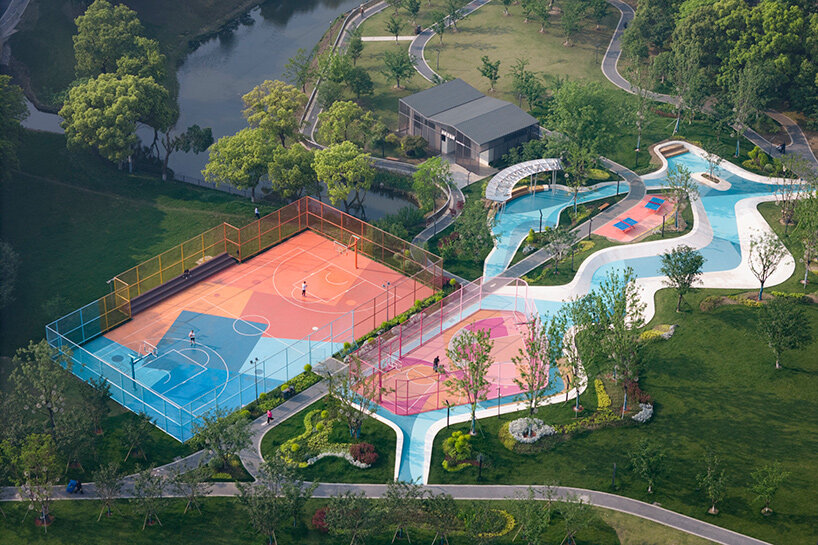
Huachiao Vibrant Sports Park (read more here) | image © Arch-Exist Photography
In Miami Beach, Playlab collaborated with Argentine artisans, Jessica Trosman and Emiliano Miliyo to transform discarded football nets into monumental textile installations for The ReefLine, suggesting that sporting equipment can carry cultural histories long after the game has ended.
The evolution continues to expand beyond individual commissions. At Casa Axis, the artist residency founded by Felipe Pantone outside Valencia, the sports court becomes the center of an entire cultural program. Its inaugural Casa Axis International Open replaces traditional rankings with a tournament built around artists, played on a court designed by MrKA and accompanied by an exhibition featuring works from the Muñoz Collection. The winning artist is invited to redesign the court for the following edition, turning the playing surface into an evolving commission.
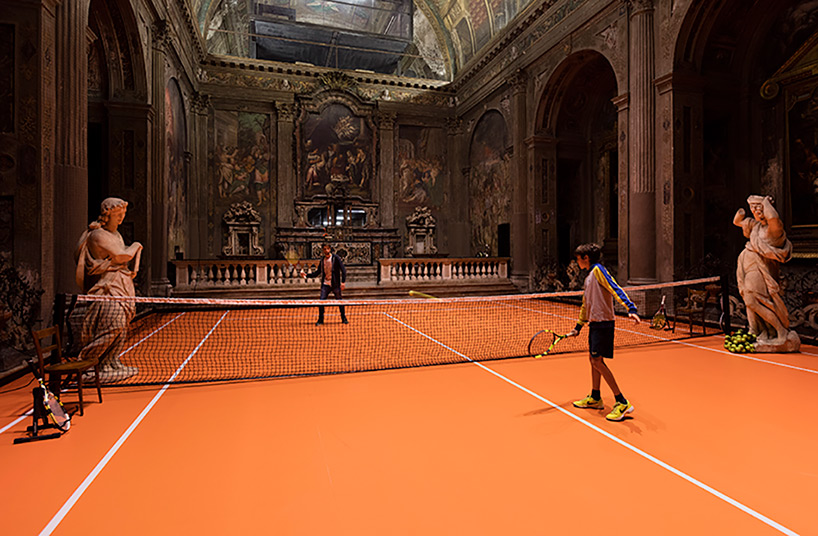
Untitled (plot for dialogue) by Asad Raza (read more here) | image © Andrea Rossetti
more than a place to play
The progression from Pigalle’s painted gradients to Casa Axis’ artist-led tournament suggests that the sports court has evolved into a platform for testing ideas about graphic design, architecture, participation, and public life, without ever abandoning its original purpose. Unlike many forms of public art, these projects are not complete until someone steps onto them, introducing movement rather than observation, asking players, neighbors, and passersby to become part of the work itself.
Perhaps that is why the sports court has proved so compelling. It is one of the few public spaces that already belongs to everyone, and designers come just to reveal the creative potential of one that has been hiding in plain sight.

Creative Courts Canary Wharf London by | Yinka Ilori | image by Matt Alexander

image courtesy of Felipe Pantone’s Casa Axis
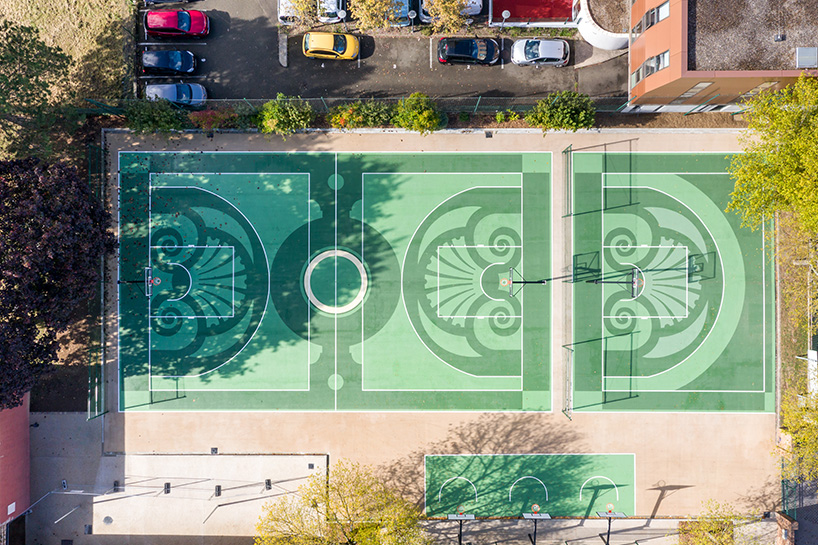
Playgones’ French-Style Basketball Court (read more here) | image courtesy of City of Versailles / Pierrick Daul

Frontones Danzantes by 2050+ (read more here) | image by Josema Cutillas

Big Goals by PlayLab (read more here) | image courtesy of Veronica Ruiz
This article is part of designboom’s Play chapter, exploring what happens when creators prioritize emotional warmth, vibrant geometries, and tactical leisure. Discover more related stories here.
The post the court as canvas: how sports grounds became one of design’s favorite public spaces appeared first on designboom | architecture & design magazine.