





activated space: allan kaprow’s happenings and their afterlife in immersive environments


a room, a body, a set of instructions: the birth of the happening
Allan Kaprow dissolves the art object in the late 1950s, replacing it with an event, a room, a body, a set of instructions, and the irreducible friction between them. His ‘happening,’ first staged in 1959 at New York’s Reuben Gallery as 18 Happenings in 6 Parts, divides the space into three rooms separated by semi-transparent plastic sheets, where painters, performers, and slide projections operate at the same time, and where participants receive instruction cards telling them when to move, sit, or applaud. The ninety-minute work refuses plot, symbol, and the passive act of looking, proposing instead a ‘plastic composition’ in time and space, one in which the body of the visitor is not an appendage to the work but its animating condition.

Comfort Zones, 1975, 16 mm film transferred to video on DVD, b/w, sound © Allan Kaprow Estate
Allan Kaprow and the logical conclusion of action painting
Kaprow arrives at the ‘happening’ through a reading of abstract expressionism pushed to its logical limit. In his 1958 essay The Legacy of Jackson Pollock, he argues that if Pollock’s genius lay in the ‘action’ of painting, then the canvas itself is an unnecessary remainder, a concession to the commodity form. Influenced by John Cage’s chance-based musical theories, developed in the New School courses both artists share, Kaprow begins treating the gallery not as a neutral container but as a scored environment. Yard (1961), which fills the courtyard of the Martha Jackson Gallery with hundreds of discarded tires, makes the proposition concrete: the art is not the tires but the act of climbing through them, the body’s negotiation with resistant material. Space, for Kaprow, is volume activated by movement.
By the mid-1960s, ‘happening’ had migrated from avant-garde shorthand to pop-cultural currency, used to describe any gathering considered sufficiently fashionable. Kaprow responds by abandoning the term entirely, moving toward what he calls ‘activities’, small-scale, private, task-based works conducted outside gallery settings, often involving ordinary gestures repeated until they lose their legibility. In his 1966 essay Notes on the Elimination of the Audience, he writes that the boundary between the ‘happening’ and daily life should remain as fluid and indistinct as possible, pressing toward a condition in which the category of ‘spectator’ becomes simply inapplicable. The work is designed to be remade rather than reconstructed. Each new realization responds to its specific participants, its specific moment, operating in what Kaprow calls a ‘continuous present tense.’

Yard 1961 Courtesy Allan Kaprow papers, 1940-1997, Research Library, The Getty Research Institute, Los Angeles, California (980063) © Ken Heyman-Woodfin Camp Photo: Ken Heyman
The Experience Economy and Its Discontents
The contemporary immersive industry inherits Kaprow’s activated space and extends it across radically different registers. teamLab’s philosophy of ‘borderlessness’, where digital patterns respond in real time to the movements of visitors, carries a direct echo of Kaprow’s participatory framework. The viewer is integral to the image’s formation, and no two visits are identical. Their environments pursue aesthetic unity and sensory immersion on their own terms, the ‘synchronous interaction’ generating a collective experience in which the boundaries between artwork, viewer, and space dissolve continuously.
DRIFT occupies a different register. Their Fragile Future series, in which real dandelion seeds are hand-glued to LED circuits, fuses organic and technological material in works that ask for contemplative presence, while large-scale performances like Drifters, concrete monoliths appearing to float, operate through a shared suspension of perceptual certainty. Carsten Höller pursues the participatory proposition through a scientific and bodily logic. Test Site (2006) installs monumental slides in the Turbine Hall of Tate Modern, offering each visitor the binary of observation or participation, and using the mechanism of the slide to stage an involuntary shift in bodily agency.

Fragile Future | image courtesy of DRIFT
The Quantified Participant
The introduction of AI-mediated systems has altered the mechanics of participation at a structural level. Computer vision platforms now track gaze, movement, and biometric state, allowing environments to adapt their outputs in response to audience data in real time. The artist’s role shifts from author to system architect, and authorship itself becomes distributed across the interaction between human intention, algorithmic process, and participant input. This ‘closed feedback loop’ is, in one sense, a technical fulfillment of Kaprow’s desire for a work that changes each time it is realized, but it operates through the accumulation and optimization of data rather than the embrace of open-ended chance. Research into AI-mediated design suggests a threshold effect: when the algorithm’s contribution exceeds a certain proportion of the output, participants cease to identify the work as their own.
The ‘death of the spectator’ Kaprow pursued as a democratic ambition has, in some iterations of this model, been replaced by the production of what critics describe as the ‘prosumer’, a figure who simultaneously consumes the experience and generates content for its dissemination.
What survives of Kaprow’s intervention is a persistent question: under what conditions does a space become a situation, and how is that situation shared? The ‘happening’ endures as an unresolved ambition running through every design practice that treats space as something to be activated rather than composed. Whether that ambition is honored, diluted, or absorbed into the logics of the experience economy depends, as Kaprow would have insisted, on who is in the room, and what, precisely, they are asked to do.

Yard: Overhead view 1961 Gelatin Silver print Courtesy Allan Kaprow papers, 1940-1997, Research Library, The Getty Research Institute, Los Angeles, California (980063) © Ken Heyman-Woodfin Camp Photo: Ken Heyman

Fluids 1967/2012 1967/2012 Version by the Department of Art Theory & Practice and the Mary and Leigh Block Museum of Art, Northwestern University. Installation view, Mary and Leigh Block Museum of Art and Art Theory and Practice Department, Northwestern University, Evanston IL, 2012 © Allan Kaprow Estate

Fluids 1967/2008 1967/2008 Version by LACMA, Los Angeles CA. Installation view, ‘Allan Kaprow—Art As Life’, LACMA, Los Angeles CA, 2008 © Allan Kaprow Estate

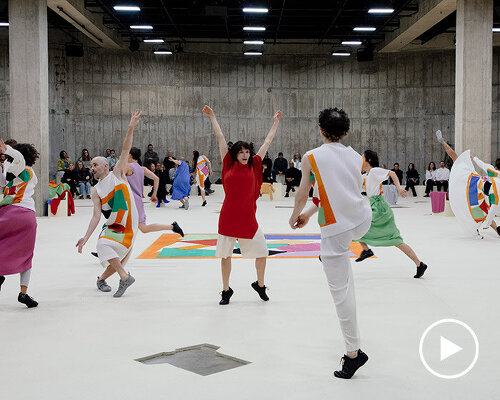
18 Happenings in 6 Parts 1959/2014 1959/2014 Version by Dora García. Installation view, ‘Allan Kaprow. Other Ways’, Fundació Antoni Tàpies, Barcelona, Spain, 2014 © Allan Kaprow Estate

Installation view, ‘Allan Kaprow – Art as Life’, The Geffen Contemporary at MOCA, Los Angeles CA 2008 Photo: Brian Forrest

Installation view, ‘Allan Kaprow. Paintings, Drawings, Happenings, Environments’, Museo Novecento, Florence, Italy 2020 © Museo Novecento Photo: Leonardo Morfini
This article is part of designboom’s Dreams in Motion chapter, exploring what happens when we treat our dreams and reveries as an active, radical rehearsal for impending material realities. Explore more related stories here.
The post activated space: allan kaprow’s happenings and their afterlife in immersive environments appeared first on designboom | architecture & design magazine.