






how ecoLogicStudio uses a practice of repair to grow buildings that breathe


toward a softer infrastructure
In place of grand technological fixes, emerging practices are beginning to align with slower, more reciprocal processes by working with living organisms, cultivating attention, and embracing the ongoing labor of maintenance and care. Projects like those developed by environmental design practice ecoLogicStudio imagine environments not as static solutions, but as evolving relationships between human and non-human actors, where even microscopic life becomes an active participant in shaping collective futures.
The group’s projects sit close to the idea of a future carried by subtle shifts and ongoing repair. Air becomes the main site of work, and the act of designing prioritizes tending and sustaining. Led by Claudia Pasquero and Marco Poletto, the studio builds environments where performance builds gradually through biological activity.
Rather than relying on large-scale technological fixes, microalgae circulate through transparent structures, absorbing carbon dioxide and releasing oxygen. These processes stay visible. Tubes cloud and clear, colors deepen or thin out, and the atmosphere changes slowly in response to light and occupation. Architecture here takes shape through metabolism, with space defined by what moves, grows, and requires upkeep. These projects do not present solutions as finished objects, but as evolving systems that require attention, maintenance, and coexistence. In doing so, they point toward a way of thinking that privileges interdependence, ecological sensitivity, and the subtle, continuous work of sustaining life.

ecoLogicStudio founders Claudia Pasquero and Marco Poletto with H.O.R.T.U.S. XL Astaxanthin.g, Centre Pompidou, Paris, 2019
ecologicstudio builds with living matter
The team at ecoLogicStudio integrates photosynthetic organisms directly into spatial systems. Bioreactors (vessels which provide a controlled environment for the cultivation of microorganisms), act as walls, partitions, and filters, thus shaping both enclosure and climate together. Their presence shifts the way a project is experienced and introduces a atmosphere tied to growth cycles.
This approach carries a different set of demands. Systems need feeding, cleaning, and adjustment. Those actions become part of the architecture itself. The work holds onto these processes instead of hiding them, and emphasizes the ongoing effort required to sustain a living environment.

Photo.Synthetica curtain (process), ecoLogicStudio (Claudia Pasquero, Marco Poletto), Dublin, 2019. image © NAARO
liquid gardens that clean the atmosphere
In the Photo.Synthetica series, ecoLogicStudio develops installations that bring air purification into public view. Networks of tubes circulate dense green cultures to form a facade that shift in tone and opacity throughout the day. Light passes through the liquid at different intensities and casts a filtered glow into the surrounding space.
The work gives presence to something usually unseen. Air is treated as material, and its transformation becomes spatial. These installations stay close to the scale of the body, allowing visitors to move through and alongside systems that actively process the environment.
Installed in Dublin, Ireland in, a 2019 version of Photo.Synthetica uses the power of algae to absorb carbon dioxide from the air. Shaped as an ‘urban curtain’, it captures CO2 from the atmosphere and stores it in real-time: approximately one kilo of CO2 per day, equivalent to that of 20 large trees.

Photo.Synthetica curtain, ecoLogicStudio, Dublin, Ireland, 2018. image © NAARO
bringing the forest inside
The Deep.Forest installations extend these ideas into enclosed settings. Suspended bioreactors and diffused lighting create interiors defined by atmosphere rather than solid surfaces. The air carries humidity and scent, and the light shifts through layers of algae.
Space is shaped through density and movement. The environment responds to its own internal conditions, adjusting as cultures grow and circulate. The project offers a different reading of interior architecture, where climate and biological activity guide the experience.

Deep.Forest, ecoLogicalStudio, Louisiana Museum of Modern Art, Denmark, 2023. image © Rasmus Hjortshøj
spaces for breathing and recovery
With its AirBubble restorative space, the studio works at the scale of breath. Enclosed volumes generate pockets of filtered air, offering places to pause within polluted urban settings. The boundary is soft, defined by membranes and air pressure, while the interior holds a distinct microclimate.
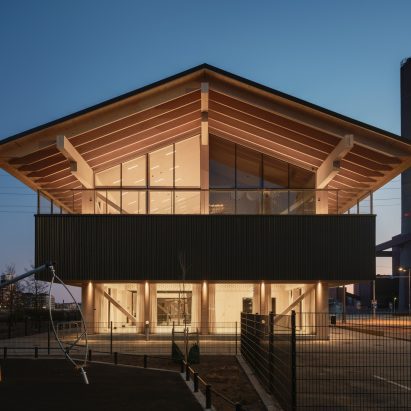
The 6-meter-tall cylindrical timber structure is wrapped in ETFE and set on a landscaped mound. At its core, 36 glass bioreactors hold 350 liters of Chlorella algae that filter polluted air at 150 liters per minute. The liquid traps particles while the algae absorb pollutants and CO2, releasing oxygen. Its inverted conical roof supports natural ventilation and continuous air circulation.
These environments bring attention to the act of breathing. Air quality becomes tangible, shaped through living systems that require ongoing attention. The project sits close to questions of health and environmental care, approached through spatial means.

AirBubble restorative space, ecoLogicStudio, Nyon, Switzerland, 2024. image © Pepe Fotografia
networks of living systems
Projects such as CryflorE imagine the city as a distributed field of living infrastructure. Developed as a modular hexagonal system, each unit hosts photosynthetic organisms embedded within biogel panels that absorb carbon dioxide while producing energy. These fragments connect into a larger network, where biological activity and urban performance operate together, turning building surfaces into active environmental interfaces.
Energy and information move across the system through conductive pathways inspired by natural growth patterns, allowing the network to adjust over time. Light signals and digital feedback make these exchanges visible, translating metabolism into a spatial condition. Within this framework, architecture extends beyond a single site, shaped through ongoing interaction between organisms, materials, and data, and sustained through continuous engagement.

CryflorE on cyber gardening the city, ecoLogicStudio, Lausanne, Switzerland, 2025. image © Synthetic Landscape Lab (Xiao Wang)
form shaped by growth
The visual language of ecoLogicStudio’s work comes from the behavior of its materials. Tubes, membranes, and fluid geometries follow the movement of living cultures. Color shifts track concentration and activity, giving surfaces a sense of duration.
Form changes over time. Geometry adapts to support the organisms it contains, allowing spatial conditions to evolve alongside biological processes. The work stays open to variation, and is shaped by the materials which it hosts.

bI.O.serie living interior wall system, ecoLogicStudio, Frankfurt, Germany, 2020. image © Sven Moschitz / MSPT
the labor behind living architecture
Sustaining these environments depends on ongoing work. Light levels are adjusted, nutrients are introduced, systems are cleaned. These actions keep the architecture functioning and define its lifespan.
The studio keeps this labor present within the project. Maintenance becomes visible and integral, shaping how the space is understood and used.
ecoLogicStudio’s projects move through incremental change, engaging environmental questions through systems that grow and adapt over time. Their work aligns with Radical Softness through its focus on attention, repair, and sustained engagement.

Air Bubble air-purifying eco-machine, ecoLogicStudio, Warsaw, Poland, 2021. image © NAARO
project info:
studio: ecoLogicStudio | @ecologicstudio
The post how ecoLogicStudio uses a practice of repair to grow buildings that breathe appeared first on designboom | architecture & design magazine.