



building with air: from warhol’s inflatables to A.A. murakami’s bubble dress


pneumatic environments and the politics of impermanence
Inflatable environments, atmospheric installations, suspended membranes, and pneumatic structures persistently resurface across museums, biennales, galleries, and public space, often reappearing in moments marked by instability, exhaustion, and shifting social conditions, yet almost always generating a peculiar sense of wonder and lightness. Forms drift above visitors’ heads, pulse with circulating air, or dissolve into fog, transforming atmosphere itself into something tactile.
From Tomás Saraceno’s airborne ecosystems and the lingering afterlife of Diller Scofidio + Renfro’s Blur Building to the radical experiments of Ant Farm, Haus-Rucker-Co, Hans-Walter Müller, and the floating choreography of Merce Cunningham’s RainForest, artists and architects have repeatedly returned to air as both material and method. Invisible yet infrastructural, immaterial yet capable of reorganizing perception, behavior, and social relations, air becomes paradoxically physical once contained. Stretched across membranes, trapped inside vinyl skins, suspended within architectural envelopes, and circulated through pneumatic systems.
Gagosian’s exhibition dedicated to Christo and Jeanne-Claude’s pneumatic works is centered around the long-unrealized Air Package on a Ceiling, from 1968, a vast suspended membrane hovering just above visitors’ heads, turning air into architecture and foregrounding the unstable conditions required to sustain it. Organized around the idea of air as invisible, intangible, and essential, the exhibition revisits the moment wrapped objects evolved into atmospheric environments. Value no longer emerged solely from the object itself but from acts of containment, tension, suspension, and temporary transformation, works that proposed a spatial condition grounded in instability, perception, responsiveness, and encounter.
Even the body has begun to behave pneumatically. At the Met Gala, A. A. Murakami’s Airo dress for Iris van Herpen released streams of fragile bubbles that hovered briefly before disappearing.
The thread that connects these otherwise distant projects is not simply a shared aesthetic language of inflatables or softness, but an alternative perspective of how space behaves. These structures drift, sag, hover, wrinkle, collapse, and inflate again, resisting fixity. They depend on climate, pressure, maintenance, collective attention, and continuous negotiation to remain alive. Air only becomes perceptible through containment, and these works repeatedly expose how fragile that containment actually is.

Andy Warhol. Silver Clouds [Warhol Museum Series], 1994, reprint 1994. Helium-filled metalised plastic film (scotchpak), Flat balloon: 88.9 x 132.1 cm; Inflated: 81.3 x 121.9 x 38.1 cm. The Andy Warhol Museum, Pittsburgh. © The Andy Warhol Foundation for the Visual Arts, Inc. / SOCAN (2021). Installation view, Andy Warhol, July 21, 2021 – October 24, 2021. Art Gallery of Ontario. Photo © AGO
building with air: when strucutres learned to breathe
In Warhol’s Silver Clouds (1966), giant helium-filled pillows bob just above head-height, their mirrored skins catching light. Viewers chase them playfully, each collision sounding a gentle ‘fup’ or ‘bouf’ as one curatorial note marveled. These drifting shapes seem to dissolve into space. In a vivid memory of 1968, Merce Cunningham set dancers loose in this cloud of Warhol balloons for RainForest, a scene of anarchic whimsy. Neither dancer nor object follows any fixed beat. By simply containing air, these works make it visible and unpredictable.
In that same era, architects and artists embraced ‘air buildings, nomadic visions,’ as the counterculture called them. The Viennese group Haus-Rucker-Co, for example, fashioned wearable helmets and inflatable chambers that ballooned gymnasiums into otherworldly spaces shaping a moment of altered perception through these ‘air-inflated architecture and wearable appendages… designed to alter participants’ social and perceptual experiences’. On the US West Coast, the collective Ant Farm famously offered giant nylon pillows and inflatable domes for rock festivals and ecology events. Ant Farm’s 50×50-foot inflatable ‘pillow’ became a stage for Earth Day performances, and their guerrilla ads in zines boasted of custom ‘air buildings’ ready to be deployed. These anti-buildings encouraged participation: anyone could sew plastic sheeting and hook up a fan.
Ant Farm even self-published the Inflatocookbook (1971), a do-it-yourself manual, opening up information for inflatable structures to anyone who wants it. The effect in person was revelatory, as viewers wandered through grass or desert, a 16mm film later showed them in delirium among gigantic pulsating pillows. Early inflatables created fluid, amorphous environments where people giggled and relaxed under parabolic shapes. Soft forms drifted whimsically, responding to wind, heat, and human touch. They pointedly rejected any notion of an everlasting ‘monument,’ operating instead as collective, improvised experiences.
fog, pressure, and the disappearance of the monument
Christo and Jeanne-Claude, who are better known for wrapping islands and monuments in fabric, also played with air. In 2013 Christo inflated a half-million-cubic-foot ‘envelope’ of white nylon inside a decommissioned gasometer in Germany. Two giant fans kept the 90-meter-tall balloon upright, so visitors could step through airlocks into its pearly whiteness. Inside, the world looked softened and colossal; Christo described it like a vast bath of light, saying that when it was finally installed, ‘the fabric very much transports the light. You are virtually swimming in light’. In this cathedral-sized cloud, air itself was the structure. Of course it needed constant maintenance, technicians monitored pressure, and without the fans it would simply collapse, but that very fragility became its point. The air did all the work, turning the pavilion into a floating form.
A decade earlier, Diller Scofidio + Renfro had made this logic explicit with the Blur Building (2002). Built for Expo.02 on a Swiss lake, Blur was literally a steel frame pumping out rain: 35,000 fine-water nozzles sprayed a continuous fogbank. The architects described it as an architecture of pure atmosphere. From the ramp, the public ascended into a white haze where sight and sound vanished: ‘all visual and acoustic references were erased’ on that misty deck. On the platform one found only white noise and one’s own footsteps. Entering Blur was like stepping into a habitable medium, a fog that was ‘formless, featureless, depthless, scaleless, massless, surfaceless, and dimensionless’. Movement inside was unstructured. Visitors were free to wander, to lose themselves in the intangible. Here again, what might have been a blank screen became a space made of water and light. The pavilion even featured a bar where people could ‘drink the building’, sampling bottled waters of all kinds, a reminder that the building itself was literally made of water. The Blur Building had no walls, it dissolved itself into weather.

Blur Building by Diller Scofidio + Renfro
atmospheric futures and inflatable ecologies
Tomas Saraceno’s dreamscapes carry this lineage into today’s ecological moment. His airborne ecosystems take the idea of ‘breathing architecture’ to the extreme. Saraceno fills galleries with massive inflated bubbles and spider-web nets that sway with air currents, suggesting cities that float in the sky. He often says, ‘it’s 99.9 percent air,’ describing works like On Space Time Foam, an ethereal habitat of thin membranes suspended 24 meters above the floor. In Saraceno’s vision, the new raw material of architecture isn’t concrete at all but water, air and gas: ‘What steel was to the cities of the 20th century, perhaps air will be to those of the new millennium,’ he writes.
His Cloud Cities proposals sketch communities of buoyant cells that drift like cumulus in a blue sky. As Saraceno asks, why not have ‘cities that float in the air… join together like clouds,’ creating a truly global ‘first international city’ carried on thermals? The answer lies in how these structures behave. Soft spheres inflate, tether, deflate, heal seams and pulse with wind and sunlight. They invite people to climb inside, to feel the gentle sway. And crucially, Saraceno’s floating modules are never left alone: scientists, local communities and even children help assemble them, testing them and tending them like ecosystems.
Even now, air continues to return as environment. At the 2025 Met Gala, artists A.A. Murakami collaborated with Iris van Herpen on Airo Dress, a wearable pneumatic environment for skier and model Eileen Gu. The garment continuously released iridescent bubbles through hidden microprocessors and pressurized gas systems, transforming couture into a living atmospheric event. More than 15,000 hand-formed glass elements surrounded the body like a suspended membrane, while floating bubbles drifted outward in delicate sequences before dissolving into air. The dress behaved like a temporary weather system: inflating, dispersing, evaporating, and reforming in real time.

Eileen Gu in the Airo Dress | image via @irisvanherpen
sustained by pressure and care
From Silver Clouds to Cloud Cities, these soft, volatile works are not permanent. They become visible only by enclosing air, turning the invisible into form, and remain ephemeral without constant care. Even in their heyday, physicists, meteorologists and engineers were conscripted to keep them aloft. Blur had automated weather sensors adjusting fog nozzles, Christo’s Big Air needed a continuous airflow, Saraceno’s balloons rely on sympathetic wind patterns and solar heating to float. Hans-Walter Müller, a pioneer from the 1960s, literally moved into this paradigm. In 1973 he built and still lives in Volume M210, a two-story inflatable house, showing ‘the nature of the construction principle brings with it no real limitations… simply a question of the ability of the responsible parties to think their way past the challenges’. Müller has become known as a kind of ‘champion of living architecture.’ One wall of his home is brick, but the other wall is just taut air, breathing as he does. If the fan stops or the tube springs a leak, the house literally deflates. It is architecture as organism, requiring a community (even if just one resident) to monitor and inflate.
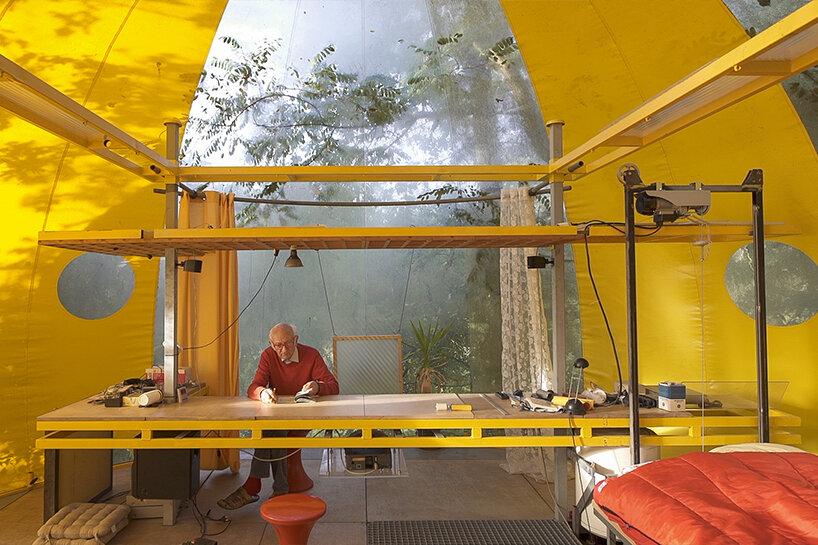
inside Hans-Walter Müller’s inflatable home | image © Lukas Schaller
what remains after monumentality
In our present moment, these ideas resonate anew. We face climate uncertainty, economic precarity, and a sense that nothing is as solid as it once seemed. No wonder soft constructions are reappearing in art and design. Floating pavilions, inflatable stages, and responsive habitats in biennales, design weeks and festivals. They remind us that space can be cared for by making themselves vulnerable to wind, to heat, to audience touch. In a whisper-light gallery of floating silver pillows or a cathedral of mist, one hears not an architect’s signature but the hushed calls of caretakers.
As the fog slowly lifts or the helium drifts to the ceiling, these works ask us to consider architecture as a fleeting interplay of forms, forces, and people.

Christo and Jeanne-Claude with 42,390 Cubic Feet Package, Minneapolis, Minnesota, 1966

Cloud Cities | © Jens Ziehe photography

Ant Farm’s Inflatocookbook (1971)

Installation view, Christo and Jeanne-Claude, 42,390 Cubic Feet Package, Minneapolis, Minnesota, 1966

image courtesy of Tomás Saraceno
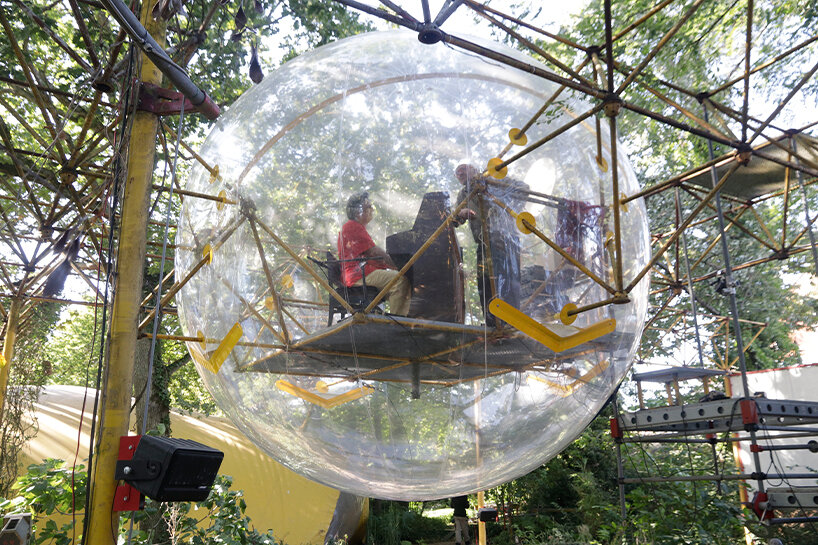
Hans-Walter Müller’s sound structure with a resonance sphere on the grounds of La Ferté-Alais | image © Marie-France Vesperini

On Space Time Foam, 2012. Transparent crystal clear pvc membrane, velcro, wood. 20.5 x 24 × 24 m Installation view at Hangar Bicocca, Milan, Italy
The post building with air: from warhol’s inflatables to A.A. murakami’s bubble dress appeared first on designboom | architecture & design magazine.