

Lost Hide exhibition at Melbourne Design Week finds new uses for leather offcuts



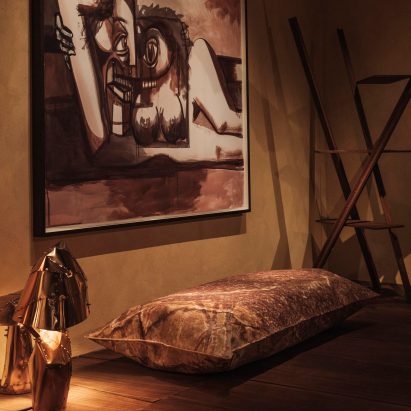
From a pair of armchairs made from contrasting hides to a tyre swing wrapped in reclaimed leather and a shaded floor lamp, the Lost Hide exhibition explores creative uses for leftover leather.
Located at the historical Abbotsford Convent in Melbourne, Lost Hide features bespoke works by 13 Australian designers made using 70 hides supplied by Swiss Design, a custom furniture maker based in Sydney.

Curated by designer Emma Elizabeth and presented by online creative hub Local Design as part of Melbourne Design Week, the exhibition spotlights Australian designers through their conceptual work that focuses on material innovation, particularly leather.
Real leather made from the skin of an animal, known as a hide, is a flexible material used in furniture making. The hides used in this exhibition are leftover upholstery leathers from Swiss Design.
"Lost Hide becomes a study of material, culture, form and time. Finding beauty not through perfection, but through what is reclaimed, remade, revived," Elizabeth said.

Two Soft Spot armchairs created by Sydney-based industrial designer Adam Goodrum are among the items on display at the show. Designed for Australian furniture brand Nau, Goodrum used contrasting sides of the leather to upholster different parts of the chairs.
The outer shell is wrapped in the grain side – the outer layer of the leather – which has a light tan, while the seat pads are upholstered in the underside of the leather, which has a deeper hue. The softer, more tactile quality of the material reveals its natural creases and irregularities.
"This contrast draws out a relationship between protection and vulnerability, between a held, structured shell and a more relaxed, belly-up softness that invites touch," explained Goodrum.

Goodrum also introduced the XO Lighting collection to pair with the armchairs. These were made from electroplated reflective hand-blown glass supported by bronze frames, creating an atmospheric light that nods to 1970s Italian design.
Sydney-based lighting design and manufacturing practice ADesignStudio's Jagged Edge installation, meanwhile, comprises a tall floor lamp and a smaller table lamp.

According to the designer Alex Fitzpatrick, the limited-edition works aim to explore how glass can be built into a surface that holds colour and changes light.
For each lamp, his team hand-cut three-millimetre tinted glass into a series of slivers in various sizes, edges, and tones. The glass pieces were then turned sideways and carefully stacked, creating a design that Fitzpatrick described as "drawing lines with material instead of paint".
The warm colour of the lamps was informed by the changes of natural light colours throughout the day, which the layered glass helps to catch, bend and filter.

"From a distance, the surface can feel soft and layered. Up close, you can see the individual pieces and the time held in the making," said Fitzpatrick.
"When the lamps are switched on, bands of colour and shadow move into the room. The work is not only what you see in the object, but also what it sends into the space around it," he continued.

Another lighting design created for the show was the Kiro Floor Lamp designed by Leah Martin, a lighting designer from Sydney.
Referencing mid-century design, a series of leather and parchment shades were connected through a handmade brass framework at various heights.

"The Kiro Floor Lamp explores the quiet beauty of emergence and balance through gently rising stems and layered lampshades that form a sculptural presence," explained Martin.
"Emerging from the centre at different elevations, each stem reflects the natural unevenness of growth – a nod to the way we evolve at our own pace while echoing the branching structure of a tree canopy," she continued.
Ben McCarthy, another industrial designer from Sydney, presented the Field Objects collection, comprising a foldable sling chair, a firewood carry bag, a tyre swing, and a stone axe.
The collection was intended to celebrate outdoor country life through crafted materials, and took a playful approach to its design.
The tyre and the upholstered leather were both salvaged, while the stone axe was hand sculpted in soapstone – the softest stone available – lending a fragility to an object that was designed for brutal force.

"These pieces sit between function and reflection. They are practical in origin, but here become slower, more deliberate, more fragile, celebrating the gestures of hand making and the pure tactility of a luxury material," said McCarthy.
Architecture and interior practice Richards Stanisich developed a chair covered in hand-stitched leather scraps that form a new skin for the chair. The design was informed by Japanese armour, armadillo scales and traditional roofing shingles.
The overall idea behind the exhibition was to uncover the beauty of overlooked materials.
"Leather bends itself towards light, offcuts rise and become frame, surfaces hold the trace of touch, of time, of wear, of change," Elizabeth concluded.
"These are not merely objects here, but fragments of another way, where sustainability and collectability exist within the same refrain."
The photography is by Matthew McQuiggan.
Lost Hide is on show from 14 to 24 May 2026 as part of Melbourne Design Week. See Dezeen Events Guide for more architecture and design events around the world.
The post Lost Hide exhibition at Melbourne Design Week finds new uses for leather offcuts appeared first on Dezeen.