





GS Architecture retrofits Hampstead Passive House with "fabric-first approach"



Local studio GS Architecture has completed its renovation and extension of a family home in Hampstead Heath, London, updating it to meet low-energy Passivhaus standards.
Named Hampstead Passive House, the semi-detached Victorian home was overhauled to create a more comfortable, light-filled dwelling with significantly reduced energy consumption.

GS Architecture set out to achieve the rigorous Passivhaus EnerPHit standard, which certifies low-energy buildings that have been refurbished with high levels of insulation and airtightness.
It upgraded the house with improved insulation and triple-glazed windows, while introducing solar panels, low-energy lighting and a mechanical ventilation and heat recovery system.

"Sustainability was central to the brief – the clients were committed to creating a home that performed as efficiently as possible, and Passivhaus EnerPHit offered a clear and ambitious benchmark for the project," GS Architecture partner Guy Stansfeld told Dezeen.
"A fabric-first approach underpinned the design, with careful attention given to insulation, airtightness and breathability," added Stansfeld.
"The use of wood fibre insulation and traditional lime plaster was key, allowing the existing building shell to be made airtight while still breathable."

As part of the project, GS Architecture replaced the home's existing conservatory and extensions with a new timber-framed addition.
Topped with a wildflower green roof, this rear extension houses an open-plan kitchen and dining space, with timber doors opening out into the garden.

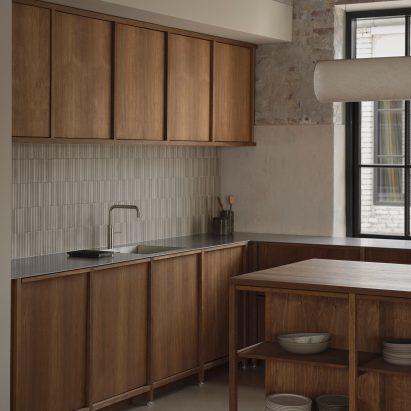
Inside, the space combines a variety of timber elements, including the kitchen island and cupboard fittings, the dining table and a built-in bookcase.
Timber finishes appear alongside reclaimed materials such as old snooker-table slate used for the kitchen worktops, complete with original brass studs and pocket cutouts.

Other reclaimed and repurposed elements include salvaged floorboards used to line the extension's ceiling and for internal door facings, while cupboard doors are made from former cheese-manufacturing boards.
According to the studio, new materials and finishes were carefully selected to avoid petrochemical-based products. Clay from the rear garden was mixed into the lime-based paint for the walls, contributing to its natural look.
A wide opening connects the kitchen-dining room to a sitting room beyond, complete with the same pale timber flooring, natural palette and matching bookshelves.
Working alongside GS Architecture, designer Boris Vervoordt introduced a palette based on the Japanese design philosophy of Wabi-sabi, which celebrates imperfection.

Existing features were preserved to retain the home's character, including the original curving timber staircase.
Upstairs are three bedrooms, complete with the same pared-back palette, with pale timber cupboards and floorboards, and a neutral colour scheme.

"Texture plays a leading role in shaping the atmosphere of the home," said Stansfeld. "Lime plaster walls create a subtle sense of movement and warmth," he described.
"Natural materials such as timber, slate and limestone add depth and variation, while the colour palette remains grounded and earthy."

In the bathrooms, dark tiles are paired with dark Tadelakt walls and ceilings, a traditional Moroccan waterproof plaster, chosen by the studio for its natural breathability.
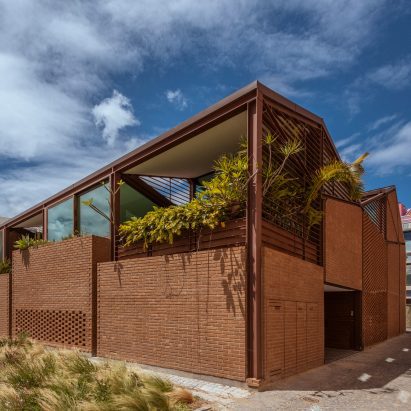
Other homes designed to Passivehaus standards recently featured on Dezeen include a house in Chile featuring multiple courtyards and "the largest Passive House building in Canada".
The photography is by Matt Clayton.
Project credits:
Architect: GS Architecture
Energy consultant: Ecospheric
Structural engineer: MBOK
Kitchen joinery: Brockhampton
Main contractor: OLF Construction
Interior design: Axel Vervoordt Co
The post GS Architecture retrofits Hampstead Passive House with "fabric-first approach" appeared first on Dezeen.